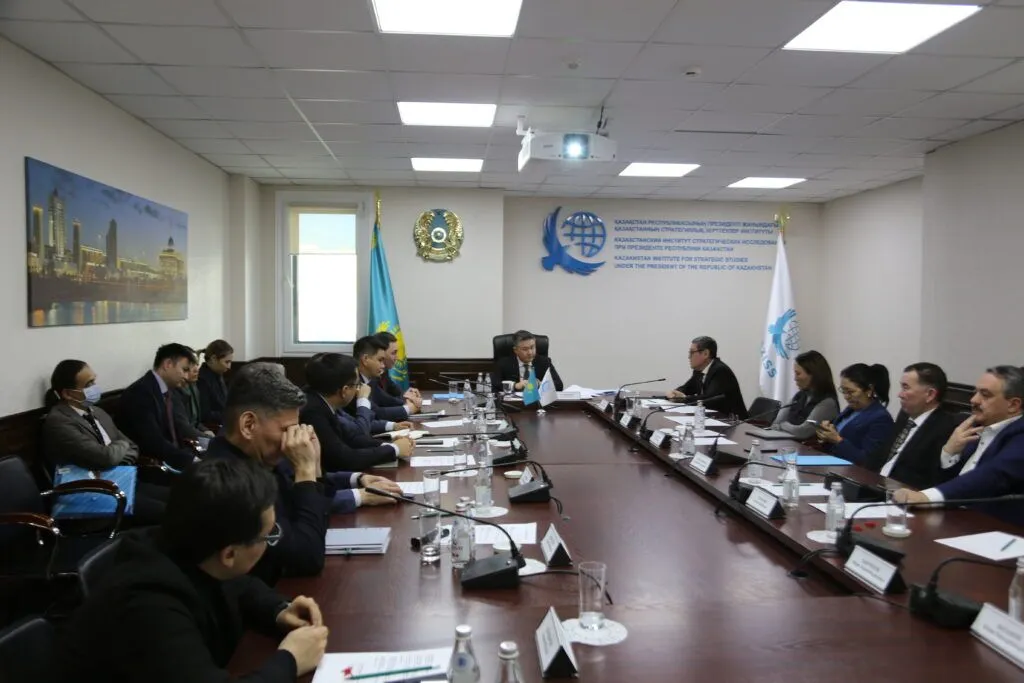
The next meeting of the economic club was held at the Kazakhstan Institute for Strategic Studies under the President of the Republic of Kazakhstan, where the project of the National Development Plan "Kazakhstan-2029" developed by the Agency for Strategic Planning and Reforms of the Republic of Kazakhstan (ASPR) was discussed. The agency has done significant work in forming this strategy; at the same time, experts expressed interest in its review and refinement. The discussion of this important document for the country was attended by the chairman of the economic club – the head of the National Bank of the Republic of Kazakhstan Timur Suleimenov, the chairman of the Agency for Strategic Planning and Reforms Jandos Shaimardanov, the director of KISI Erkin Tukumov, the deputy chairman of ASPR Olzhas Tuleuov, the managing director of "Jusan Analytics" Anuar Kuandykov, deputies of the Mazhilis of Parliament, leaders and representatives of analytical and consulting centers, and prominent economists of the country.
The head of the National Bank of the Republic of Kazakhstan Timur Suleimenov noted in his speech that such an important document as a development plan should be present in any state: "The demand for this from society and the expert community is quite high. We need a medium-term strategy, the results of which we will specifically feel in the coming years. This document was developed by the decision of the Head of State, where ASPR is the main developer, and a large number of state bodies and expert communities were also involved. I am sure that many of those present here also took an active part. Nevertheless, the document in its entirety was published relatively recently. There are various reviews and ideas, so today we have gathered all interested experts at the KISI platform to work on constructive proposals."
The director of KISI Erkin Tukumov noted that this is an important and necessary document, and that expertise and constructive assessment are required from economists: – We proposed the KISI platform for expert discussion of the National Development Plan project "Kazakhstan-2029". Considering that the President has repeatedly spoken about the importance of the expert community's participation in the preparation of the country's strategic documents, including on the new economic policy, it is important for us to understand and promptly refine this document and explain in accessible language to citizens how this strategy will serve the interests of the entire population of the country, how our state will develop, and what visions of the future we are building. What will GDP and the indicators of the real sector of the economy be in its implementation, how will the well-being of citizens improve (an important factor is inclusiveness), will the population have equal access to improvements in life, education, and medicine. In other words, an accessible understanding for an ordinary person of what our country will be like in the near future, how the life of every Kazakhstani will improve. There is a lot of work to be done on all these and other components, and we need our balanced opinion.
The chairman of ASPR Jandos Shaimardanov thanked KISI for the good opportunity to discuss the important document – the project of the National Development Plan of the country. – The document has already undergone a number of discussions with state bodies, and on February 5 it was published on the open NPA portal. We received a lot of feedback, comments, and proposals from the expert community. In developing the document, we involved not only state bodies but also Kazakh and foreign experts. Discussions are still ongoing on various platforms. The document is still in development; this is not the final version yet. During the discussion, we are refining it and plan to launch the third stage of coordination with state bodies at the end of February – early March, – the speaker reported.
The deputy chairman of ASPR Olzhas Tuleuov noted that the current situation in the global economy poses different tasks in creating the National Plan project for the Republic of Kazakhstan until 2029: – The future now looks quite different from what we envisioned ten years ago. It was predicted that international economic cooperation would strengthen, trade barriers would decrease, and the global economy would grow. Today, protectionism is becoming an increasingly common phenomenon in developed countries such as the USA and the EU. The market era of the 90s has practically ended with the onset of the pandemic and has led to a reassessment of what is coming – a period of rebalancing.
Mazhilis deputy Albert Rau focused on the issue of population income: – The main goal set by the President is economic growth and an adequate increase in the well-being of the population. We need to understand how the doubling of GDP will correlate with the growth of population income.
The issue of economic inequality in access to infrastructure in the regions was raised by Mazhilis deputy Nikita Shatalov: – We emphasize and allocate resources more to the social block. While healthcare and education are the areas that provide our people with growth, this is a matter of increasing professional competencies and developing human capital.
Rakhim Oshakbaev, chairman of the board of trustees of the TALAP Applied Research Center, emphasized the need to create favorable conditions for improving the quality of life: – We can take into account the methodology of the index, which measures 37 countries. The main complaint is the inclusiveness of economic growth; it is not visible. Doubling GDP, but where is the person?!
Managing director of Visor Holding, economist Almas Chukin is confident: we need to increase our own production capacities: – The document should include a list of specific problems by sectors, their solutions, and understand how much all this will cost us. There are two paths – either increase income or reduce expenses and see the figure of what the budget will be by 2029.
The idea of building a consolidated budget was supported by Murad Temirkhanov, economist and advisor to the chairman of the board of Halyk Finance JSC. In his opinion, it is necessary to detail everything and conduct an applied analysis of the income-expenditure part, to build a model on which the budget will depend: – The most important thing is the productivity indicators, which have been declining over the past 6-7 years. At the same time, there is a shortage of investments in large projects. For gas, there is a deficit for domestic consumption and a lack of investment because domestic prices are lower than export prices. This is where the role of the state should be. But to make a leap in the economy, structural changes are needed – privatization and the construction of a real sector of the market economy.
According to Yerlan Smailov, a member of the Public Chamber under the Mazhilis, it is necessary to include the implementation of the national plan in the KPIs of the government and ministries: – If our priority now is to increase the Kazakh content, if there is an increase in the indicator of country value, then it is probably worth establishing performance indicators for the government and relevant ministries on key indicators of technological complexity of the economy.
The issue of investments was supported by comments from Marat Kairlenov, director of the consulting company Ulagat Consulting Group. According to him, the investment policy needs to be revised, as the discussion of the list of projects goes on year after year, and systemic changes are needed: – We have a number of proposals for revising the investment policy. The indicators do not reflect the situation in Kazakhstan, as frozen accounts have increased fivefold; it is necessary to actively create jobs. One of the measures could be the cancellation of the recycling fee for motorists.
All proposals and comments resulting from the expert discussion were taken into account.