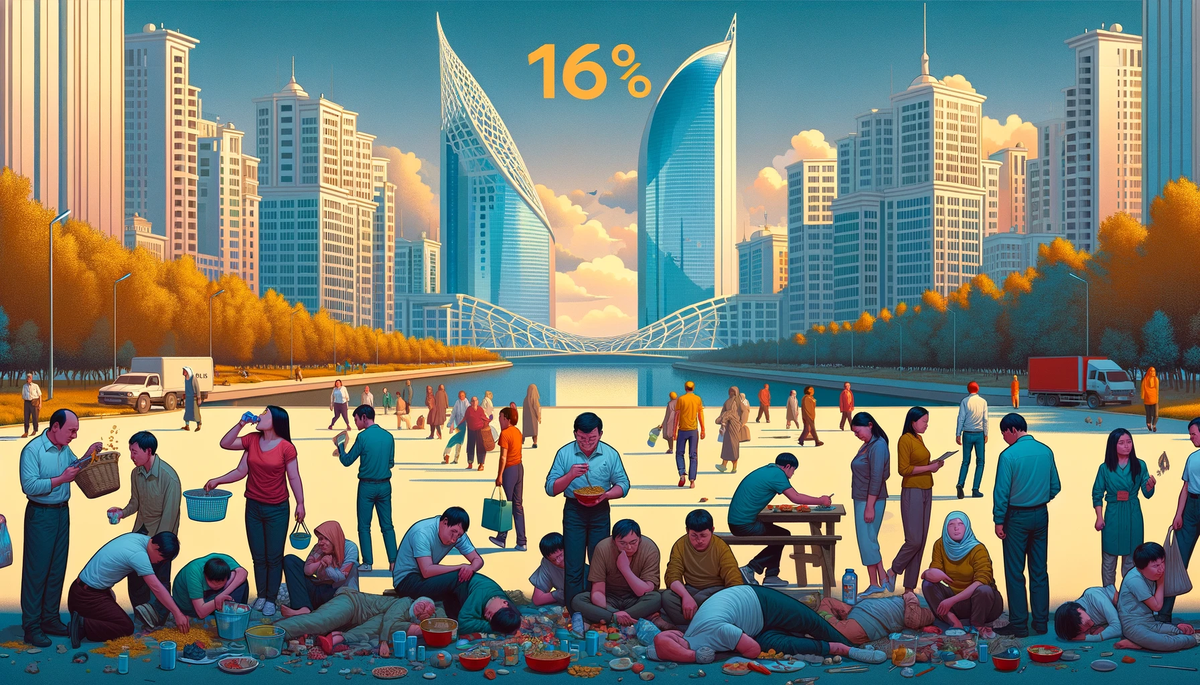
We learned from the authors of the study about the harmful habits of our compatriots, the main causes of insomnia, the search for joy in sugary drinks and fast food. And also about whether Kazakhstanis are ready to become healthier and help others take a step towards active longevity.
The warranty on the body and the four horsemen
TALAP representative Rakhim Oshakbaev, known to Kazakhstanis for his active work in the economic and social sphere, says: after 45, the topic of health has become a priority for him.
“As they joke, after this mark, the warranty on the body ends… I personally felt that for active longevity, one needs to change their lifestyle. And there is no direct link between healthcare spending and the health of the population. The fundamental problem is that the healthcare sector in Kazakhstan is not interested in the health of the nation, but in maximizing expenditures in the system, increasing the number of jobs, and treated cases,” notes Rakhim Oshakbaev.
At the same time, within the parameters of OECD countries, which our republic aspires to, two important indicators are highlighted: life expectancy and self-assessment of health by consumers on a scale from 0 to 100.
“More than 30 of the most developed OECD countries compare the effectiveness of the healthcare system and the health of the nation. We do not have such metrics. There is also no publicly available information on the dynamics of chronic diseases and the main causes of mortality,” says the interlocutor.
Kazakhstanis, like residents of other countries, are threatened by the four horsemen of death: diabetes, cardiovascular, neurodegenerative, and cancer diseases, the economist reminds. However, the effectiveness of allocated funds in the context of a healthy lifestyle (HLS) and the prevention of the four horsemen of death is not measured in specialized programs.
“In November, we conducted a survey of 1,200 Kazakhstanis in all regions on the topic of HLS and everything related to it. This is a unique study for our country. More than half of Kazakhstanis believe that they do not lead a healthy lifestyle, which means they are doomed to the imminent appearance of chronic diseases, which are the main factors of mortality. Only 25% of our citizens monitor their nutrition, 75% eat what they want, 28% smoke, 20% are dissatisfied with their weight, 31.1% have sleep problems. Only slightly more than 16% of Kazakhstanis consider themselves healthy, from which we draw a sad conclusion - our nation is sick,” says Rakhim Oshakbaev.
Photo: Rakhim Oshakbaev - representative of the Center for Applied Research "TALAP"
Almost 72% of respondents agree that one should lead a healthy lifestyle, while 52% believe they are more physically active, and 32.5% allocate time for this several times a week.
“The key to improving the health of the nation is not in increasing spending on the healthcare system. The OSMS has become a fake insurance, an uncontrolled quasi-state solidarity fund, not tied to actual health indicators with low efficiency at high costs. The same low efficiency is shown by the meager expenditures from local budgets on promoting HLS. In Kazakhstan, no one is interested in your health except for yourself,” believes the economist.
Health economics
Director of the Center for Applied Research "TALAP" Askar Kysykov states: there is a deficit of surveys on HLS and overall health of citizens in Kazakhstan, although this is a fundamental topic of national scale and one of the key indicators for measuring the nation.
“At health forums, officials talk about how many hospitals have been built, how many doctors have been invited, what equipment has been purchased. But doctors treat diseases - they do not talk about health. And to this day, according to our data, there has not been a single study on Kazakhstanis' self-assessment of their own health. There is a vacuum in the country regarding HLS and not enough advocates for such a lifestyle. And we would like to start filling this gap through research as well. We will share the results of the survey with medical professionals, with whom we have been closely working since the COVID-19 pandemic,” says Askar Kysykov.
In the topic of HLS, the key question is the desire of the individual to be healthy, believes the economist who adheres to the principles of HLS. Among other things, he has given up sugar, increased physical activity, and reduced stress.
“In the topic of HLS, upbringing plays a significant role. The habit of eating in a certain way is instilled in families. Many do not even know how to cook healthy dishes: mom cooked fatty food, and the daughter continues this family tradition. Traditional national cuisine is also quite high in calories, with a lot of fats. Many Kazakhstanis love to eat national dishes, I am no exception, but I try not to consume them often,” says Askar Kysykov.
Existing problems with nutrition, which many Kazakhstanis do not monitor, are related to the income of the population, acknowledges the economist.
“Healthy eating requires more time and quality, often expensive products. Many in the country often consume fast food because it is cheap, and SMEs, responding to this demand, open more corresponding food outlets. One of the directions of our research on HLS was how the government can stimulate citizens to give up harmful habits. Various mechanisms are used: direct bans on advertising harmful products, increasing excise taxes on tobacco, alcoholic, and sugary products,” notes Kysykov.
According to most respondents, the government cannot ensure full control over the enforcement of bans, as seen in the case of hookah - it is officially banned in Kazakhstan, but it can be ordered in any establishment.
“Most respondents consider effective measures in the fight for HLS to be a ban on advertising harmful goods and informational propaganda. Increasing prices on harmful products is supported by 11.3% of respondents. The government is going down the path of bans and increasing excise taxes, but in the case of the latter factor, another side comes into play - the growth of cheap and even more dangerous smuggling of surrogates,” emphasizes the interlocutor.
Photo: Askar Kysykov - director of the Center for Applied Research "TALAP"
Kysykov agrees with Oshakbaev that in Kazakhstan, health is the concern of the citizens themselves.
“For example, even when there is a desire to eat properly, I find it difficult to find information about what is harmful and what is beneficial. That is why nutritionists and Instagram coaches on HLS are spreading so widely in the country. Moreover, many of them contradict each other, and by promoting something in this area, they harm people. Doctors and scientists do not recognize these pseudo-specialists. So, in all this variety of misinformation, it is difficult to navigate. For example, there are widespread myths about superfoods: eat avocado - you will be healthy, or pumpkin seeds. But nutrition should be diverse and balanced. The current topic is also dietary supplements and vitamins, as it is already impossible to meet the need for vitamins and minerals through food under current conditions. But one must also be careful with dietary supplements, taking them after consultations with specialists,” reasonably believes the expert.
Smoke less, drink less, and stress less. Sleep less too
Head of the sociological research service Evgeny Khan revealed interesting facts identified during the survey of Kazakhstanis on the topic of HLS.
“We decided to look at the issue more broadly - not only from the perspective of HLS and harmful habits but also the corresponding psychological attitudes of Kazakhstanis. We managed to create various profiles and behavior models of respondents, including taking into account generational and other differences, to further promote HLS,” says Evgeny Khan.
The expert highlights several key findings from the conducted research. The first is the perception of HLS.
“72% of Kazakhstanis believe that one should adhere to a healthy lifestyle. This idea is popular among the population. What does HLS mean in the eyes of the population? For example, such a parameter as physical activity. Not everyone who talks about the need for HLS engages in physical activity (exercises, sports, walks) at least weekly. And many of those who believe there is no need for HLS do this,” says the interlocutor.
According to the research, the following parameters show the maximum differences: those who believe that one should adhere to HLS more often monitor their nutrition, are more satisfied with their weight, consume dietary supplements and vitamins more often.
“Also, such respondents smoke less and consume alcohol less, experience stress less often, get sick less often, and visit doctors for preventive check-ups more often. They do sleep, however, on average less. Nevertheless, they fall asleep more easily and wake up more refreshed than others. As we will see further, largely thanks to physical activity. Overall, public opinion on HLS is a set of social profiles that gradually transition into each other. But the path to HLS in Kazakhstan can be called long. At the same time, HLS has high potential for development in the country,” notes the sociologist from TALAP.
Sleep quality is one of the most important health indicators. Many countries face the problem of reduced sleep. Kazakhstan is no exception.
“15% of Kazakhstanis sleep less than six hours a day. Almost every second Kazakhstani sleeps less than 8 hours (48%). It is important not only how much a person sleeps but also how they fall asleep and wake up. 31% of respondents report that they have difficulty falling asleep. 40% wake up heavily, taking a long time to 'get going'. The maximum sleep problems are among those over 50. Among them, every second person has difficulty falling asleep,” continues Evgeny Khan.
As the expert clarifies, there is no clear dependence of low sleep quality on stress or on how much a person sleeps. However, there is an obvious dependence of sleep quality on whether a person leads a physically active lifestyle or not. So, if we want to improve the sleep quality of Kazakhstanis, the path is clear.
You are what you eat
The next key parameter is healthy eating. 25% of Kazakhstanis monitor their nutrition. 44% do this sometimes. 29% prefer to ignore this issue. Similar figures apply to fruit consumption.
“A market for dietary supplements and vitamins has also formed in the country. 9% consume them regularly, 14% often, and 39% - sometimes. Among those who monitor their nutrition, there are three times more who report excellent health than among those who do not monitor or do so occasionally. The more often people eat fruits, the easier they fall asleep and wake up well. And vice versa. The absence of fruits in the diet leads to people having difficulty falling asleep and waking up. Research on how people's diets change under inflation pressure shows that fruits are the first to disappear from it,” reveals the sociologist's nuances.
Accordingly, as the economic situation worsens, one can expect a decline in the quality of nutrition, which will lead to a deterioration in health, particularly increasing sleep problems.
“Interestingly, the number of people who say they monitor their nutrition is approximately the same across all age groups. These are value attitudes related to HLS that have already taken root in Kazakh society. Regarding unhealthy eating and its consequences: 20% of respondents are dissatisfied with their weight and would like to change it. Weight concerns primarily affect respondents under 29 years old. This is related to both objective and subjective reasons. On the one hand, this age group has the peak consumption of fast food, and on the other, it is the age of maximum demand for their appearance,” says Evgeny Khan.
26% of young people often consume fast food. With age, the number of such frequent consumers decreases. A similar situation exists with sugary drinks: among young people, this figure reaches 38% (compared to an average of 27%). 15% of young people often drink energy drinks (compared to an average of 10%).
“The analysis of the survey results records a generational shift in harmful habits. Young people talk about positive feelings from sweet carbonated drinks and, conversely, are more critical of alcohol. Unlike older generations, who more often think the opposite. It is noteworthy that fast food and sugary drinks are consumed significantly by both those who advocate the need for HLS and those who do not consider it important. These products have become realities of our lives. The difference between social groups is only in the frequency of consumption,” clarifies the interlocutor.
Mom, we are all a little sick
Physical health and visits to doctors - only 16% of Kazakhstanis say they are completely healthy. 9% report poor health. The rest prefer satisfactory ratings.
Photo: Evgeny Khan - head of the sociological research service "TALAP"
“According to the survey, this statistic is no worse than in many other post-Soviet countries. However, this does not indicate a healthy society. Even at the age of under 30, only 29% of respondents report excellent health. From 30 to 50 years, this number immediately drops to 12-13%, and after 50 years - to 7%. The most vulnerable generation is 41-50 years old. They spend more than 10 hours a day sitting, sleep less than 8 hours a day more often, and smoke more often,” emphasizes the sociologist.
How significant is the role of medicine in supporting HLS in the country? According to the survey, 7% regularly visit a doctor for preventive check-ups and 30% do so periodically. That is, 37% do this in one way or another.
“If we look at how the frequency changes with age, it turns out that those who visit doctors often are from 50 years old, regularly - from 40 years old, and rarely - from 20 years old. There is a prevailing trend where people turn to doctors as their health worsens, rather than to prevent this process. Only those who can be classified as people with a confident HLS (proper nutrition, physical activity, good sleep) visit doctors regularly for disease prevention, not treatment. The reason for this lies both in people and in medicine,” believes Khan.
Mental health: 31% of Kazakhstanis experience stress daily or several times a week. Only 16% reported no stress. The most vulnerable generation for stress is 30-40 years old. The least vulnerable is 21-30 years old.
“Those who are under constant stress (daily or several times a week) have difficulty falling asleep and waking up. Among them, there are more who do not monitor their nutrition and are dissatisfied with their weight. At the same time, it has not been observed that they statistically significantly tend to alcohol and smoking, eat fast food more often, or drink sugary drinks. Among the reasons that can cause stress for respondents, financial difficulties come first, followed by problems at home and work. Accordingly, a decrease in the standard of living will lead to a further increase in the level of stress in the country,” says the interlocutor.
Your house is not on the edge
Harmful habits are another interesting part of the TALAP study. 28% of Kazakhstanis smoke cigarettes. The overwhelming majority of them do so daily. 6% smoke electronic cigarettes, vapes (which are now officially banned), and 5% use tobacco heating devices.
“Smoking electronic cigarettes, vapes, and tobacco heating devices (IQOS, GLO, etc.) is more characteristic of those under 40. Hookah and smoking mixtures are more often smoked by those aged 30-40. Most Kazakhstanis do not consume alcohol. Among the consumed drinks, beer is in first place, followed by strong alcoholic beverages. Alcohol consumption increases with age, but in the 'rarely' category. Our research did not reveal elevated levels of alcohol consumption among young people, as is sometimes claimed,” notes Evgeny Khan.
Those who drink alcohol tend to believe that it helps them relax, and that a small portion has no negative impact. The less people drink, the more prevalent these beliefs are among them (essentially, denial of behavioral risks).
“Conversely with smoking: 70% of those who smoke cigarettes regularly believe that it calms their nerves. Among them, there is a higher proportion of those who experience constant stress, but it is not significant enough to speak of a connection between stress levels and smoking,” adds the expert.
How to limit harmful habits, according to Kazakhstanis?
“Direct prohibitive measures are perceived ambiguously. According to the survey, 46% of respondents believe that complete bans on smoking, alcohol consumption, energy drinks, etc. are the most correct methods to reduce their prevalence in society. And 39% are unsure about this. Interestingly, in large settlements, citizens tend to shift the responsibility for combating harmful habits onto the state, personally distancing themselves. In contrast, in small settlements, social capital is more often engaged,” notes the sociologist.
During the survey, the authors asked what respondents would do if they saw a minor on the street consuming alcoholic or tobacco products?
“42% of respondents said they would ignore this fact, 8% would contact the police, and 18% would try to find the parents and inform them. People are more likely to contact the police in large cities, while they would look for parents in small settlements. The highest level of 'ignoring' is among those aged 21 to 30. With age, it decreases. We also see that HLS advocates have a higher social responsibility (within the framework of this experiment), they would like to do something if they encounter such a minor engaging in 'harmful actions', but they find it difficult to answer what exactly,” says Evgeny Khan.
85% of respondents know that in Kazakhstan, the consumption of alcoholic, tobacco, and nicotine-containing (vapes, tobacco heating systems like IQOS and GLO) products by minors is prohibited. 82% know/some have heard that there is a ban on the consumption of alcoholic and tobacco (nicotine-containing) products in public places (restaurants, cafes, bars, etc.)
“At the same time, only 38% believe that the state can fully ensure control over compliance with prohibitive measures regarding alcoholic, tobacco, nicotine products, as well as energy and sugary drinks. People are aware of the bans but do not consider them effective. There is a correlation: the less people come into contact with harmful habits, the more often they consider bans an effective measure; conversely, the more they know about the bans, the less they consider them effective. Law enforcement practices are heavily influenced by social ones,” says the sociologist.
Another social modeling - the authors of the study asked how vape users would act if they were banned. At the time of publication of this material, such a ban had already come into effect.
“Despite the fact that the situation is relevant, we received many 'I don't know' responses - vape consumers have not yet thought about such a scenario. At the same time, very few respondents said they would intend to quit consumption in the event of a ban. The rest will look for alternative options,” reports the sociologist.
About gender and differences between cities
The findings of the study regarding the influence of socio-demographic and gender factors on HLS are interesting.
“Thus, women in Kazakhstan eat better, visit doctors more often, and are more prone to stress. However, these differences between them and men are not so great. Differences grow when it comes to harmful habits. Women smoke less, drink less, and consume fewer energy drinks. However, both men and women consume sugary drinks equally. Gender differences become truly significant when it comes to the social assessment of harmful habits. Here, women are much more categorical than men, more intolerant,” notes Evgeny Khan.
Another interesting finding is that more is said about HLS in Almaty than in Astana, but at the same time, the same number of people lead a physically active lifestyle in both Astana and Almaty. Moreover, in Almaty, there are more people leading a sedentary lifestyle and more who sleep little.
“In Astana, people monitor their nutrition more often. However, fruits and vegetables are consumed more often in Shymkent. So, they eat dietary supplements and vitamins less often there. This is done more often in Astana, where stress levels are significantly higher. Here, people visit doctors more often, smoke less, but visit fast food more often,” details the sociologist.
People with higher education are more likely to believe that it is necessary to adhere to HLS and believe that they themselves lead a more physically active lifestyle. At the same time, they are more prone to stress (they perceive it that way).
“They are more likely to consider themselves healthy. And at the same time, they visit doctors more often for preventive check-ups. Their diet more often includes fruits. They are less prone to harmful habits and more likely to believe in the effectiveness of bans on them,” adds the interlocutor.
Let's be healthy. We have everything for this
How to promote HLS? 72% of Kazakhstanis believe that one should lead an active lifestyle. Despite the high internal diversity, this is a large number of people, which allows us to speak of great prospects for the development of this direction.
“As an example, we asked people about the accessibility of various facilities for engaging in HLS. The average score ranged from 2.89 to 3.72 out of 5 possible, which can be characterized as satisfactory accessibility. Parks and green areas, public transport are the most accessible, while bicycle paths and rentals are the least accessible. Notable are the measures that, according to respondents, the city can take to encourage the spread of HLS. First of all, this is the growing number of activities, events, and then the expansion of available spaces for engagement. An analysis of respondents' comments showed that accessibility is not only about physical presence but also about free access,” emphasizes Evgeny Khan.
With age, the demand for activities and events decreases. Those over 50 prioritize accessible spaces and information about a healthy lifestyle.
“Overall, there is a general decline in physical activity with age. On the one hand, the number of those who engage daily remains stable. This is already a lifestyle for people. On the other hand, we see how the frequency of engagement decreases with age. The number of those who engage several times a week decreases, and the number of those who engage rarely increases. Accessible spaces and large-scale sports activities can correct this trend,” believes the expert.
Overall, the survey results show that various self-sustaining mechanisms have formed in society - both positive and negative.
“And promoting HLS should be based on the impact on them as a whole. Then we will achieve a synergistic effect. The strength of Kazakhstan is that we have good prerequisites for this,” believes the sociologist.