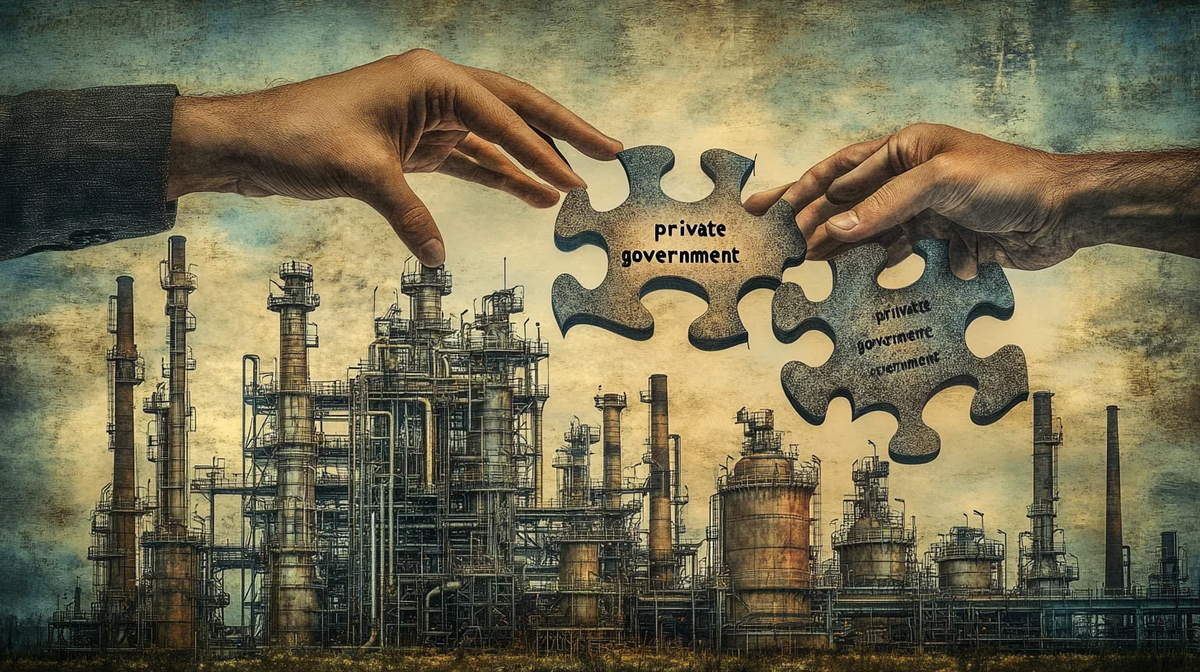
The state continues to participate in the economy
In May of this year, the President's Decree “On Measures for Economic Liberalization” was issued. The document aims to ensure freedom of entrepreneurship through the development of competition, reduction of state participation in the economy, and lowering of business costs. The decree sets the main directions for further economic liberalization and includes the following key measures: 1. Reduction of the share of the state sector in the economy through privatization and prevention of the growth of state-owned enterprises. 2. Improvement of corporate governance at JSC “Samruk-Kazyna”. 3. Ensuring equal conditions and opportunities for all market participants, curbing anti-competitive actions. Ensuring fair competition in financial markets. 4. Implementation of fundamental principles of entrepreneurial freedom. Within the framework of the decree, a National Office for Privatization has been established under the Agency for Protection and Development of Competition of the Republic of Kazakhstan. Its task is to develop criteria for state assets subject to privatization and to form the corresponding list. It should be noted that the economy of Kazakhstan has experienced more than one wave of dem monopolization of the state and privatization of state property in recent years, which have not always gone smoothly and effectively. For the qualitative conduct of such a process, it is important to make painful and not always popular decisions (for example, increasing tariffs for housing and communal services), but at the same time, it is important for the state not to create competition for the market. Recently, at the X Eurasian Antimonopoly Forum, the business ombudsman of Kazakhstan, Kanat Nurov, stated: for effective economic liberalization in Kazakhstan, a direct ban on competition between the state, state-owned, and quasi-state enterprises with private business is necessary.
“The legislation states that in the absence of competition in the market, the state has the right to enter private sectors of the economy. But we need to look for other ways – to support private businesses that want to enter there. Otherwise, political monopolies will be created again. Private business will always lose to quasi-state and state business in terms of administrative resources because the state stands behind them. And in our specific legal conditions, this is undoubtedly a loss for private business and the economy. One cannot build another plant at the expense of quasi-state funds if private business is already building it,” emphasized Kanat Nurov.
He is also confident that it is important to regulate primarily natural monopolies through tariffs, but at the same time, it is desirable to free them from profitability control – so that they use the resulting profits for network modernization, bonuses, and other things, so that they are interested in their efficiency. Of the 36 measures of the decree, 24 are planned to be completed this year. In particular, the Ministry of National Economy has imposed a moratorium on the creation of quasi-state sector entities, revised the procedure for forming the boards of directors of the “Samruk-Kazyna” Fund, updated its Corporate Governance Code, and introduced a ban on attracting state funding from the National Fund on non-market conditions for quasi-state sector entities.
“Certainly, there are sectors of the economy where the state’s presence is critically important, especially when it comes to strategic sectors important for national security, as is practiced worldwide. However, we are still convinced that in Kazakhstan, the dominance of the quasi-state sector represented by the holdings Baiterek and Samruk-Kazyna, which are key operators of the state in the economy, significantly hinders the development of real market competition and reduces the overall investment attractiveness of the country,” notes economist Galymzhan Aitkazin.
As an example of ineffective management, he cited the case of JSC “National Company “Kazakhstan Temir Zholy”, where the issue of institutional separation of the transportation business from the railway lines (natural monopoly) has long been overdue. The recently published National Report on the management of state assets and the quasi-state sector for 2023 states that the total assets of the state and the quasi-state sector (value of state property + book value of KGS assets) amounted to over 88 trillion tenge, with Kazakhstan's GDP being approximately 120 trillion tenge last year. The comparison is not ideal, but it shows the scale of state participation in the economy, economists note.
Brakes on the process
The Director of the Applied Research Center “TALAP”, Askar Kysykov, noted in a conversation with TAJ.report that despite the priorities announced by the authorities, the share of the state in the economy remains high.
“There are different indicators of state participation in the economy: in the production of goods and services, intermediary services. This is direct competition with the private sector, and the relevant industries need to exit first. There are strategic sectors: oil production, energy, uranium mining, railways, where state presence is necessary. But in many other areas where medium and small companies operate, there are many state and quasi-state structures. In the same consulting. For example, we as a research organization compete with numerous state companies that receive billion-dollar funding,” said the economist.
According to him, many associate economic liberalization only with a reduction in state participation. But this is not the case – in all countries, there is a certain level of state participation. Yes, it is commonly believed that it is ineffective in most cases, and this is a fact, however, there are also counterexamples, for instance, in China.
“In Kazakhstan, there has long been talk of liberalization, the main direction is related to privatization. In recent years, this process has significantly slowed down. In 2021, 193 objects were put up for privatization, in 2023 - 21 objects for 6.8 billion tenge. This year, three objects for 6.4 billion tenge. This is critically low. There is the so-called reduction of state participation through the placement of shares of state companies on the IPO, but we are only placing up to 10% of shares, and mostly doing this on the domestic market. Shares are mainly purchased by ENPF and financial organizations, to a lesser extent by individuals, and the effect of the IPO is insignificant, as the management efficiency of the companies does not change,” emphasized Kysykov.
Askar Kysykov - Director of the Applied Research Center “TALAP”
And this is a key problem of the Kazakhstani public sector. And ineffective management is because officials are at the helm of companies with state participation.
“Samruk-Kazyna” is a holding that owns the main state assets, managed by the government: the chairman of the board is the prime minister, and the board itself includes officials. As a result, the self-governing bodies of “SK” perform the tasks set by the government. And these tasks often contradict economic feasibility, accordingly, contradict the goal of increasing asset value and profitability of the organization. Such a direct conflict of interest,” emphasized the economist.
He stated: in Kazakhstan, the quasi-state sector is more focused on fulfilling social tasks than on increasing the profitability of these assets. However, in the correct scheme, all state assets of the company should be aimed at generating profit, which then comes to the budget through dividends, and from there - for social expenses.
“Currently, many expenses are incurred directly by “SK”. According to the holding's reports, the volume of cross-subsidization within “SK” exceeds 1.2 trillion tenge. This is a gigantic amount, which concerns reduced tariffs, cheap services of “Kazpost”, passenger transportation, and so on. The whole system, in essence, works inefficiently – I repeat, because social tasks are being attempted to be solved through the quasi-state sector. But they should be solved through the budget, transparently, approved by parliament, and so that the public can see,” said the expert, adding that when increasing the same tariffs, it is necessary to increase targeted social assistance directly.
In its current format, privatization does not increase the efficiency of managing state assets, believes the economist. Although the improvement of corporate governance is mentioned in the president's decree on economic liberalization. And this needs to be done by changing the composition of directors - attracting professional managers.
The guillotine will help us
The second major direction of liberalization is improving regulation. Our regulation is excessive, each sector of the economy is regulated by the relevant ministry, akimat.
“The official has two tools of influence in his sectors: to ‘knock out’ more budget and to come up with new rules. One accumulates on another, and as a result, we get an extremely complicated system of regulation of entrepreneurial activity. According to the latest audit, the number of requirements for business exceeds 120 thousand. The attempt to make regulation from scratch, completely replacing the old regulation with new has not been successful. Cosmetic changes were made, some requirements were cut, but the regulation system itself remained the same. I think we need to apply a strict guillotine and ‘cut off’ old requirements, replacing them with new ones developed with the participation of businesses and taking into account international experience,” said Askar Kysykov.
The third direction in the issue of economic liberalization is public procurement, which is also mentioned in the presidential decree. A new specialized law will be adopted, introducing the concept of ‘de-state procurement’.
“Many economists say that liberalization is the key to the success of the state, to economic growth and development. One cannot overdo it with liberalization in strategic sectors where state participation should be effective. And it should be understood that liberal reforms are very painful. Liberal reforms imply that there will be many losers due to rising tariffs and prices, job losses. We cannot carry out such transformations while our social support system is broken, while we cannot guarantee citizens protection from poverty, a minimum income. The state social support system must significantly increase its efficiency so that during economic liberalization, as few as possible, preferably no Kazakh families suffer,” believes the head of the research center.
He added that the system of providing targeted social assistance needs to be restructured: new criteria, proactive approaches, increased amounts of assistance, a more digital format, without unnecessary paperwork are needed.
“Currently, 80 billion tenge is allocated for all targeted social assistance in the country per year - this is a pittance for a multi-trillion budget. Although this should be the number one priority of our budget if we are talking about a socially oriented state. The budget should provide for expenses to combat poverty, protect families with children from the negative consequences of economic liberalization,” said the economist.
Approaching the market
The head of Kursiv Research, Sergey Domnin, noted in a conversation with TAJ.report that the decree on measures for economic liberalization outlines the most important areas of economic reforms, de-state-ization of the economy, as seen from Akorda.
“An important place in the decree is occupied by the transition to market pricing in the oil and oil products markets, as well as the refusal of cross-subsidization of housing and communal services tariffs. Over the next three years, the authorities of the Republic of Kazakhstan plan to bring domestic prices for oil products closer to prices in neighboring economies. This approach, firstly, will reduce hidden subsidies to consumers at the expense of oil-producing companies, including “KazMunayGas”, eliminate various gray schemes around fuel, and secondly, solve the problem of fuel outflow abroad,” noted the economic observer.
In the energy sector, tariffs are also planned to be increased, making investments in the sector competitive by introducing an investment component, which will relieve the budget from expenses for the restoration of CHPPs.
Sergey Domnin - head of Kursiv Research
“For ‘QazaqGaz’, bringing tariffs closer to market prices will mean the cessation of subsidizing consumers at the expense of export supplies, the volume of which will be reduced, and very soon this scheme will become unworkable. In the specified sectors, changes are critically important, as the continuation of hidden subsidization ultimately leads to increased treasury expenses at a time when it is becoming increasingly difficult for the government to balance the budget,” continued Domnin.
It is worth noting that this is not about the complete privatization of large state assets and the withdrawal of the state from those sectors where it is present as a player through national companies, the expert clarified.
“In Astana, they understand that conducting large-scale privatization while refusing to control national companies is irrational: worse than a state monopoly can only be a private monopoly. The government is trying to return market pricing to energy goods, which will ultimately allow it to spend less on supporting the sector in the long term,” believes the interlocutor.
Moderated appetites
The topic of economic liberalization was also discussed by experts from the analytical center Halyk Finance. As emphasized by the head of the center, Madina Kabzhalyalova, the corresponding presidential decree was issued in a timely manner, but there has been no progress in the six months since its issuance. Many deadlines for specific processes have already expired, but there is no information on the progress of the implementation of the head of state's orders in the public domain. This includes the order to the government and the National Bank to ensure the introduction of a ban on attracting state funding from the National Fund on non-market (preferential) conditions for quasi-state sector entities by September 1, 2024; the revision by July 1, 2024, of the procedure for forming the composition of the boards of directors (supervisory boards) of “Samruk-Kazyna”, its subsidiaries and dependent companies; by September 1, 2024 - updating the compositions of the boards of directors (supervisory boards) of the Fund, its subsidiaries and dependent companies through competitions for the selection of independent directors (independent members); the adoption by August 1, 2024, of additional systemic measures to reduce the possibility of the Fund's interference in the operational activities of its subsidiaries and dependent companies, including personnel decisions, procurement, and production processes; the revision by August 1, 2024, together with the National Chamber of Entrepreneurs “Atameken”, the Agency for Combating Corruption, and the Agency for Protection and Development of Competition (AZRK) of the system of regulated procurement of the Fund, taking into account increasing the transparency of processes and increasing the share of domestic value. During the discussion, the chairman of the AZRK (the agency is one of the initiators of the decree on economic liberalization) Marat Omarov noted that they are doing a good job of limiting private monopolies and reducing operators. But the work is hampered by the structure of the economy and the critically high state participation in the economy.
“There is a reluctance of state bodies to delve into approaches to privatization. Sectoral central state bodies set barriers for entrepreneurs, which runs like a red thread through public procurement, project financing, and attracting investments. The presidential decree on economic liberalization states the need to accelerate the privatization process. The National Office for Privatization under the AZRK has selected more than 1,140 companies for privatization, conducted a preliminary analysis of commodity markets involving more than 500 enterprises. By the end of the year, a final list of enterprises subject to privatization will be formed, which we will submit to the modernization commission, and then the pool will be approved by the Supreme Council for Reforms and the president,” Omarov reported.
He noted that the moratorium on the creation of quasi-state sector entities significantly demotivates ministries and the quasi-state sphere from creating operator organizations – ‘appetites have already been moderated.’
Marat Omarov - Chairman of the Agency for Protection and Development of Competition of the Republic of Kazakhstan
“Issues of deregulation are also being implemented, norms for canceling maximum prices for fuel (retail) are being introduced. LLP “Petrosun”, which previously controlled about 50% of the fuel market, has been returned to the structure of KMG, and now the wholesale fuel market is 100% controlled by the state. Maximum prices will be canceled. Changes will also affect the pharmaceutical market. The National Center for Expertise of Medicines has fully digitized the submission of applications from domestic pharmaceutical industry enterprises for the formation of maximum prices. The third direction of the decree is the decriminalization of certain types of violations of antimonopoly legislation. Now criminal liability is introduced only for anti-competitive agreements in cartels,” said the head of the AZRK.
Games in privatization
The managing director of JSC “Samruk-Kazyna” for development and privatization, Saltanat Satjan, reported that the company manages assets worth over $81 billion.
“Our goal is to maximize the long-term value of assets and attract foreign direct investment. In ‘SK’, there are 10 large assets, of which 7 companies are listed on the market with a total capitalization of $31 billion. KTZ is not yet on the market, but we see potential, and for 2025, the company is planned for privatization. But an investor will never buy a company without an attractive story, and in the case of KTZ, fair tariffs are needed. With ‘QazaqGaz’, the problem with tariffs in the domestic market has not yet been resolved - we are operating at a loss,” said Satjan.
According to her, since 2010, ‘SK’ has reduced by 600 companies, and now the fund's structure includes 300 companies.
“We are implementing a comprehensive privatization plan until 2025, more than half of the assets have been privatized. I am often asked when we will sell ‘Qazaq Air’, but it is a matter of price. For 1 tenge, I can sell it to you, and you will probably buy it. But we do not just want to sell; we want a good investor to come in. In general, economic liberalization should start with tariff liberalization,” believes the SK representative.
Advisor to the Chairman of the Board of Halyk Finance, Murat Temirkhanov, commenting on her speech, noted that analysts have the impression that there is no comprehensive approach to privatization in the country.
“KTZ, Samruk Energy, ‘QazaqGaz’ have been on the privatization list for 10 years, and for all 10 years, reforms have been planned for them. And when will they become business-attractive?.. Sam ‘SK’ says it loses 1.2 trillion tenge in lost income on tariffs for gasoline, electricity, and railways. This has been going on for years. But there is no comprehensive approach to privatization. Privatization is 10% of KMG, while a radical reduction of the state’s share in the economy is needed. And 10%, especially in the local market, is just a game in privatization,” emphasized the financier.
Murat Temirkhanov - Advisor to the Chairman of the Board of Halyk Finance
Moreover, the state is increasing its share in enterprises (CHPPs, for example), and it is also unclear how it will be with nuclear power plants in this regard. That is, again, the state is investing money, strengthening the reverse privatization process.
“KTZ's first restructuring program was excellent; they planned to leave only the main lines under state control and give the rest to the private sector. And now I heard again that they want to keep the monopoly on the transport and logistics function, again selling 10%, which will not be privatization,” said Temirkhanov.
The problem of the current development model of Kazakhstan lies in ‘state capitalism’, based on the distribution of oil rents in the economy. ‘Manual’ and anti-market (command-administrative) methods of managing the economy and distributing natural, financial, labor, and other resources within it are used.
“The state apparatus is extremely bloated, supported by an influential quasi-state sector that actively - and negatively - interferes in market relations in the economy. The largest key companies in the country are in state ownership. They dominate the economy and receive the overwhelming majority of subsidies, benefits, and preferences from the state, remaining ineffective in many cases. In addition, the share of small and medium-sized businesses in the country is extremely low – we are told about the share of SMEs in the economy being 37.7%, but this calculation only takes into account the number of people in SMEs, while the turnover factor of companies is not considered. According to our calculations, the real share of SMEs in the economy of the country is only 15%,” stated Murat Temirkhanov.
In the West, this figure reaches 60%, and it is from SMEs that the middle class emerges. Our middle class has been growing quite slowly over the past ten years.
“And the programs for the development of SMEs are not exemplary - we have only 11% of business lending from GDP. We should be crying,” added the financier.
Political will is needed
He separately focused on unfair competition in business lending.
“The decree on liberalization states that by the end of 2028, a phased transition from commodity-specific subsidies to preferential lending must be implemented, which means the continuation of unfair competition in the financial market by the state. In our opinion, it is necessary to immediately stop lending to businesses and mortgage lending at rates below market rates. If the government wants to help a certain sector of the economy with cheaper financing, it can do so without violating market relations in the financial system,” said the expert.
He also noted that since the issuance of the decree on economic liberalization in May until today, there has not been a single (!) government meeting on this topic. And in response to the words of the speaker from ‘SK’ about the high standards of the fund's work and compliance with OECD standards (to which we aspire), Temirkhanov stated that they do not correspond to reality.
“The state intervenes and decides for companies what to build, what to do. And the fact that the chairman of the board of SK is the prime minister is a gross violation of OECD standards,” said the analyst.
Economist Galymzhan Aitkazin, in turn, noted that in matters of economic liberalization, we are hitting a political component.
Galymzhan Aitkazin - economist
"Any state participation in the economy comes with the functions the government imposes on its agents — the well-known principal-agent problem. The government must be pried away from Samruk-Kazyna, which, under the pretext of supporting the economy and construction, keeps 'cutting dividends'. They have already announced that Otbasy Bank will be brought to market — which is laughable, especially given its conversion into a development institution. Overall, the national managing holdings Baiterek and Samruk are two big pockets of the government — opaque and heavily distorting market processes, pricing and subsidies. Liberalization requires political will; the rest is just talk. And one should start with the major players," the economist summed up