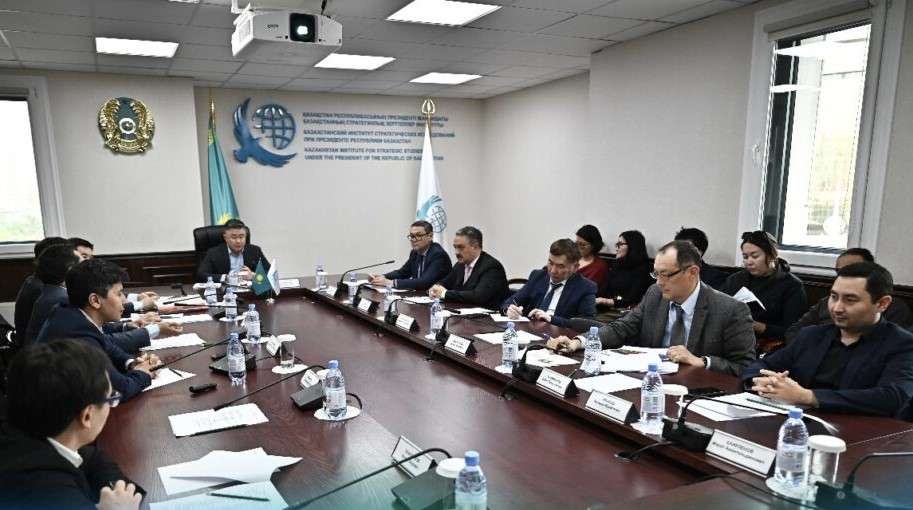
The Economic Development Council was established last year at the Kazakhstan Institute for Strategic Studies under the President of the Republic of Kazakhstan. Meetings at this venue are held under the chairmanship of the head of the National Bank of the Republic of Kazakhstan, Timur Suleimenov. The topic of the third meeting was the issues of optimizing and increasing the efficiency of public finances to ensure the dynamic development of our country.
Opening the discussion, the director of KISI, Erkin Tukumov, noted that the council is developing and demonstrating its effectiveness, attention to its work is growing, and the recommendations developed by the council members are included in many analytical materials of KISI.
As part of building a new economic model, announced by the Head of State in the Address-2023, the reform of budget policy remains a focus of government attention. Currently, the development of new Budget and Tax Codes is underway.
The chairman of the National Bank of the Republic of Kazakhstan, Timur Suleimenov, emphasized that the role of public finances is especially important for stimulating economic growth.
– Public finances affect transfers from the National Fund, which, in turn, impact the exchange rate of the national currency. The currency exchange rate largely determines the well-being and competitiveness of domestic exporters, – noted the head of the National Bank.
He proposed to utilize the potential of the expert council to develop tactics and strategies for managing public finances.
The director of the applied research center Talap, Askar Kysykov, focused on several pressing issues in the public finance system. One of them is the increase in budget expenditures without improving their efficiency.
– Over the past three years, expenditures have increased by 60%. Education, social security, and debt servicing are the main expenditure items. During 2023, about 33% of expenditures were revised (adjusted). Technocratic changes are needed in the budget planning process. This includes a new budget classification, a program structure for the budget, and an independent budget assessment, – said the speaker.
He also emphasized that the current structure of budget revenues reflects the structure of the economy. As long as oil remains the main export commodity of Kazakhstan, the budget will depend on oil revenues.
In response to the expert's remarks, the Vice Minister of National Economy, Azamat Amrin, pointed out that the large expenditures in recent years are related to the pandemic period and anti-crisis measures, as well as other social obligations. He also spoke about measures aimed at increasing the efficiency of budget expenditures.
– The new Budget Code will include a section on 'Fundamentals of Budgeting in the Republic of Kazakhstan', aimed at strengthening the principles of results-oriented budgeting. This means that every tenge of the budget should be directed towards achieving specific results. In addition, there will be a restriction on the use of targeted transfers from the National Fund only for critical infrastructure, – explained the vice minister.
Economist, managing director of Visor Holding LLP, Almas Chukin, raised issues regarding tax collection and the allocation of a large portion of the budget to cover social obligations.
– There is a mismatch between expenditures and revenues, and there are currently no solutions. The budget structure consists of 47% VAT and 30% corporate income tax. In developed countries, personal income tax has significant volumes and is the foundation of the budget. The second problem is that Kazakhstan is a social state, yet development issues account for less than 3% of the budget. The budget is largely directed towards consumption within the framework of social obligations taken on, – shared his opinion Almas Chukin.
Economist and advisor to the chairman of the board of Halyk Finance JSC, Murat Temirkhanov, emphasized that the terms, concepts, and definitions in the budget system of Kazakhstan should comply with internationally recognized standards. He also believes it is extremely important for the budget system to fully transition to international accounting and reporting standards.
Economist Arman Evniev supported the discussion on the need to disclose the mechanisms of the development budget. He believes that the budget should be defined based on the prioritization of goals and target indicators of development plans.
The chairman of the council, Timur Suleimenov, summarizing the event, instructed that all voiced recommendations be sent to the ministries of national economy and finance.
According to KISI, the next meeting of the expert council will discuss the draft of the new Tax Code.