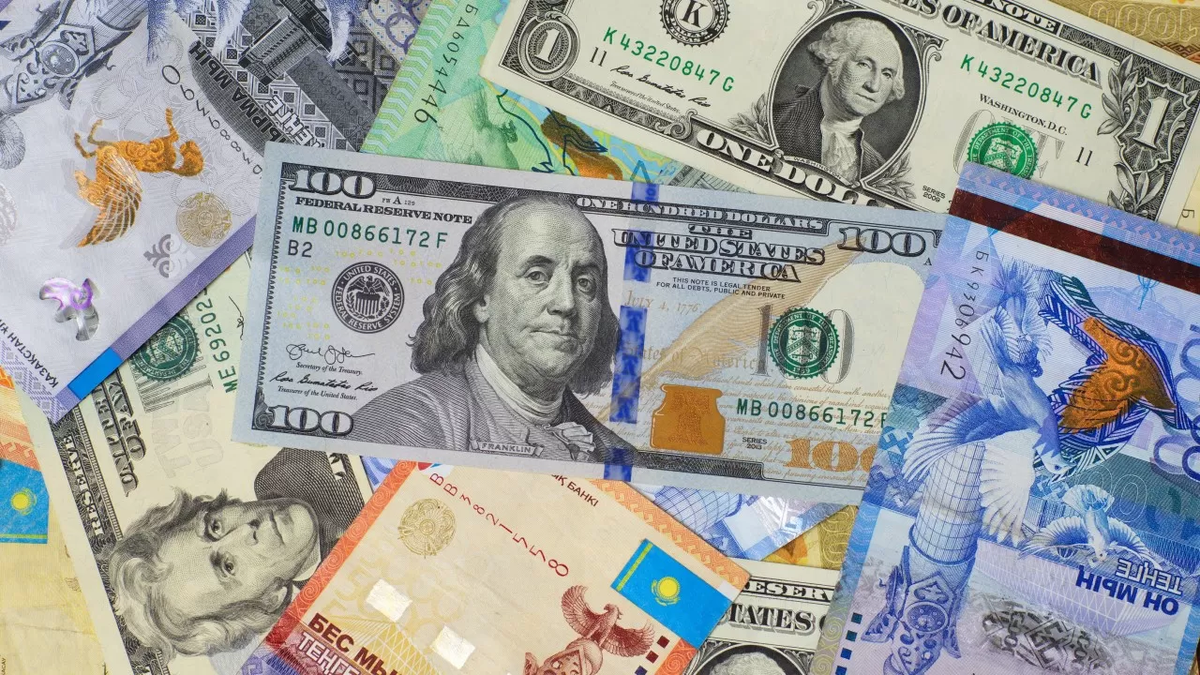
The main reason is the introduction of sanctions against Gazprombank and the weakening of the Russian ruble. Kazakhstan is heavily dependent on the ruble exchange rate, as Russia is our major trading partner. The total trade turnover amounts to 26 billion dollars, with imports exceeding 16 billion dollars and including many critically important goods.
Therefore, parity with the Russian ruble is important for Kazakhstan, which has historically been 5 tenge per ruble. Such parity allows balancing the interests of Kazakh producers and consumers. In 2014, the ruble exchange rate fell to 3 tenge, leading to mass shopping tours to Russia. In 2022, there was a period when the ruble strengthened to 9 tenge, and consequently, imports from Russia doubled in price. This was a significant pro-inflationary factor.
However, Russia quickly found a way to circumvent U.S. gas sanctions. After that, the ruble strengthened and returned to a value of 100 rubles per dollar. The Kazakh tenge remained above 500. Since the beginning of 2024, the tenge has weakened by almost 20% (from 440 to 525 tenge per dollar), while the ruble lost only 10% of its value (from 90 to 100 rubles per dollar).
So why is the tenge weakening?
In the long term, the tenge exchange rate depends on fundamental factors. Or, as the chairman of the National Bank says, "the tenge exchange rate reflects the economy of Kazakhstan." It is influenced by oil prices, trade balance, and capital outflow and inflow.
But in the short term, speculative sentiments affect the tenge exchange rate. Since the currency market is small (about 200 million dollars a day), it is relatively easy to "shake" the exchange rate. In the face of any panic, the exchange rate can fluctuate significantly against fundamental factors.
Therefore, the main drawback of a freely floating exchange rate is high volatility. It increases uncertainty in the market, raises devaluation expectations, and reduces trust in the tenge. In 2018, before the National Bank stopped conducting surveys on devaluation expectations, more than half of the population of Kazakhstan expected devaluation.
Since we are heavily dependent on imports, any weakening of the exchange rate leads to rising prices. This is compounded by the ratchet effect, where prices are fixed with a margin during a weakening of the exchange rate but do not decrease when it strengthens. This is the main argument in favor of a more managed exchange rate.
According to the IMF classification, a freely floating exchange rate is recognized as a regime with interventions less than three times in six months (less than three working days each). This condition is not met in Kazakhstan. The National Bank conducted interventions in July, August, September, October, and November 2024. Only in November did the interventions exceed 1 billion dollars. This does not take into account operations with the National Fund and the ENPF.
Until 2015, Kazakhstan operated under a currency corridor regime. The main argument against a fixed exchange rate is the burning of reserves. There is a myth that back then, in 2014-2015, 30 billion dollars of reserves were allegedly "burned" to maintain the tenge exchange rate. According to the official statistics of the National Bank for 2014-2015, before transitioning to a freely floating exchange rate, gold and foreign exchange reserves increased by 4.5 billion dollars.
Now, under a freely floating exchange rate, the National Bank continues to conduct currency interventions "to prevent excessive changes in the tenge exchange rate." However, there are no clear criteria for what is understood by "excessive changes in the exchange rate."
The National Bank uses currency interventions, sales of currency from the National Fund, operations with ENPF assets, and the requirement to sell 50% of foreign currency earnings. With such intervention, the exchange rate cannot be called freely floating. Even the IMF does not recognize the tenge exchange rate as freely floating in its reports.
The Kazakh economy, where 80% of exports consist of raw materials, is not yet ready for a freely floating exchange rate. A freely floating exchange rate automatically transfers any instability in raw material prices and the ruble exchange rate to the tenge.
In the variety of currency regimes, there are two extremes - on one side, a fixed exchange rate, and on the other side, a freely floating exchange rate. However, many countries apply transitional currency regimes. For example, a sliding peg, a sliding link to a basket of currencies, an expandable currency corridor, and so on.
The National Bank has sufficient resources and tools to manage the exchange rate without significant damage to the gold and foreign exchange reserves, which amount to 44 billion dollars. Essentially, doing the same thing as now, but consistently and predictably.
Managing the exchange rate will help smooth volatility, reduce devaluation expectations, and lessen the pass-through effect of exchange rate weakening on prices.