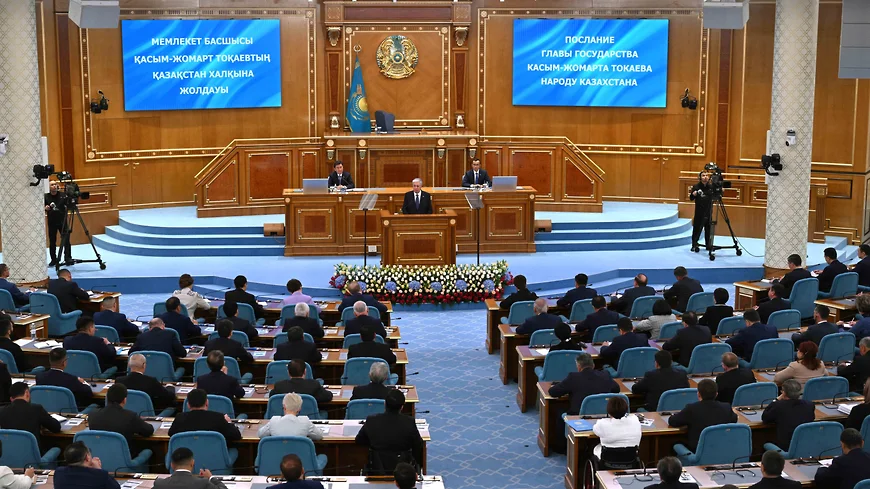
The opening of the session of the Parliament of Kazakhstan, traditionally beginning with a message from President Kassym-Jomart Tokayev to the people, was noticeably different this year from previous ones. While in 2022-2023 the messages described the conceptual principles of building a 'new Kazakhstan', in 2024 the main themes became the challenges and problems facing the country. These, along with the solutions proposed by the head of state, resemble those in Russia: a budget deficit amid the need for investment and an increase in the population's well-being requires an increase in revenue collection and redistribution — and pushes the country's authorities towards raising taxes, introducing a progressive scale for individuals, saving on government spending, and reforms in the banking sector.
Expand to full screen
Photo: official website of the President of the Republic of Kazakhstan
Kassym-Jomart Tokayev's speeches in 2022 and 2023 were conceptual in nature, as evidenced even by their titles — 'A Just State, One Nation, Prosperous Society' and 'The Economic Course of a Just Kazakhstan'. In the title of this year's message, there is more specificity: 'A Just Kazakhstan: Law and Order, Economic Growth, Public Optimism' — within this framework, the President of Kazakhstan attempted to address all aspects of life in Kazakh society during his hour-long speech. In particular, Mr. Tokayev answered two key questions, supporting direct elections of akims (heads of local administrations) and appointing a referendum on the possibility of developing nuclear energy in Kazakhstan for October 6.
However, the main focus of the message was the economic challenges facing Kazakhstan amid the overall course towards 'economic growth while reducing social inequality and strengthening the middle class' (a formula, it should be noted, that almost repeats the policy implemented by the authorities of the Russian Federation, excluding 'the middle class').
To achieve this, it will be necessary to increase the efficiency of public administration and carry out a number of reforms. Key issues identified include 'the imbalance between monetary and fiscal policy', problems with 'the investment climate and conditions for doing business', and questions regarding 'unlocking the industrial potential of the country'. The President of Kazakhstan demanded that the government and the National Bank 'stimulate banks to invest more funds in the economy', revise their taxation, and adopt 'a new banking law that meets the current tasks of stimulating economic activity'.
Separately, the head of state called the two-year failure to fulfill the revenue part of the republican budget 'a major miscalculation in the work of the previous and current governments'. The government is forced to resort to additional transfers from the National Fund to cover the budget deficit. According to experts' estimates, the revenue plan for this year (16 trillion tenge excluding transfers from the National Fund) will be underfulfilled by 3 trillion tenge. 'If we add a deficit of 3 trillion tenge to this, the budget gap is approximately 25% of the expenditure part,' says Askar Kysykov, director of the TALAP Center for Applied Research. According to the budget projections approved by the government for the next year, the volume of transfers from the National Fund will increase further — to 5 trillion tenge.
The way out of the situation is to 'live within our means', the head of Kazakhstan stated yesterday. 'The government, together with the National Bank, must take effective measures aimed at the efficient use of budget funds, limiting and strictly controlling expenditures,' he demanded in his message. Also among the requirements is the creation of conditions for the growth of business activity and private investment. 'The new Tax Code is intended to reboot the existing system. The Code should aim at building a fundamentally new tax administration based on trust in taxpayers. It is extremely important to simplify the code, making its provisions understandable for all economically active citizens,' said the President of Kazakhstan, agreeing to postpone its implementation from 2025 to 2026 for quality development. The head of Kazakhstan outlined three key points of the proposed tax reform: an increased tax rate for banks (according to Mr. Kysykov — including an increase from 20% to 25% on income not related to business lending), a progressive tax scale for individuals, and an inventory of benefits. 'Tax reporting should be provided for all benefits. Those that genuinely stimulate business should be retained,' said Kassym-Jomart Tokayev.