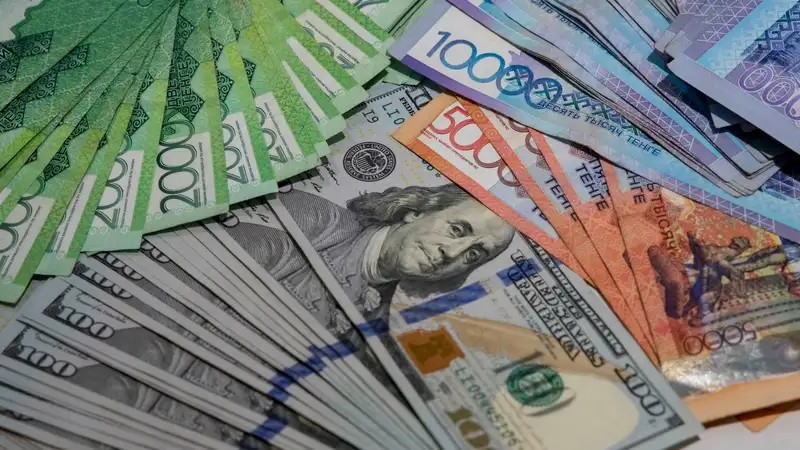
To begin with, it is necessary to try to understand why the dollar is falling, how much further it can drop, and how long this trend will last.
Tax revenues, expensive oil, and a strong ruble
According to Askar Kysykov, the director of the Talap Center for Applied Research, one of the main reasons for the rise in the exchange rate of the tenge is the activity of the National Bank of the Republic of Kazakhstan. Despite the declaration of a free exchange rate, the NB RK actively intervenes in exchange rate policy through indirect currency interventions and the use of funds from the National Fund and the Unified Pension Fund, the expert believes.
"The current strengthening of the tenge is related to the active sale of National Fund assets in the currency market. This is done due to the non-fulfillment of the republican budget in terms of taxes, and it is necessary to finance current expenses. The government is rapidly implementing guaranteed transfers, which, of course, strengthens the tenge," said Askar Kysykov.
Currently, tax revenues to the treasury amount to only 16% of GDP, while government expenditures are about 23% of GDP, noted the analyst.
The expert's words were confirmed by the National Bank.
"Currency sales from the National Fund to ensure transfers to the republican budget in April amounted to 1,056 million dollars. The share of sales from the National Fund accounted for 21% of the total trading volume and no more than 48 million dollars per day," the NB RK stated in a release.
Another reason for the appreciation of the tenge, according to Kysykov, is the strong ruble, as the economies of Russia and Kazakhstan are very closely linked. Today, the ruble is extremely strong, and this is a significant support for the tenge.
"Historically, the exchange rate of the ruble to the tenge has been one to five. And if, for some reason, the ruble falls, the National Bank of the Republic of Kazakhstan will likely start to let the tenge go as well," said Askar Kysykov.
USD/KZT (NB RK). Photo: nationalbank.kz
At the same time, it is encouraging that the prices of oil have less and less influence on the formation of the tenge's exchange rate, the analyst notes.
"We have seen how oil prices have 'floated', but the tenge has not experienced significant fluctuations. This is largely explained by the fact that the tenge's exchange rate has become a political phenomenon. It determines the pace of inflation, and thus, stability in society," said Askar Kysykov.
Will the tenge fall again?
According to Askar Kysykov, predicting the further behavior of the exchange rate is quite difficult. However, there are two trends that can provide approximate forecasts.
The first trend is that our national currency will inevitably gradually fall against the dollar. And there are no foreseeable reasons for the dollar to weaken against the tenge in the near future. The second reason is that the budget of the Republic of Kazakhstan for 2024 has set the dollar value at 460 tenge.
Interestingly, analysts predict a different exchange rate:
"If the government adheres to the previously established limits on transfers of 3.6 trillion tenge in 2024, this will sharply reduce monthly currency sales from the National Fund and lead to the weakening of the tenge. In this case, our forecast for the exchange rate at the end of 2024 at 485 tenge per dollar looks quite realistic."
So, should you urgently buy dollars today?
Here, it is necessary to understand what you need American money for. If the goal is to protect against possible depreciation of the tenge, then you should buy. But if the goal is to make a profit, then you need either to operate with millions of dollars, which, let's agree, is not available to everyone, or not just buy and then sell dollars, but invest in dollar-denominated assets.
On the other hand, it is not at all necessary to invest in hard currency today, believes analyst Vladislav Antonov.
"Let's calculate. If in a year the dollar rises to 585-590 tenge, that would only be a 7% increase. But you can also open a deposit in a bank at 16% for six months and earn well on a tenge deposit," said Vladislav Antonov.
In general, it is always necessary to adhere to the reasonable and long-standing principle: do not put all your eggs in one basket. It is more profitable to keep part of your savings in tenge, part in currency, and part in other assets.