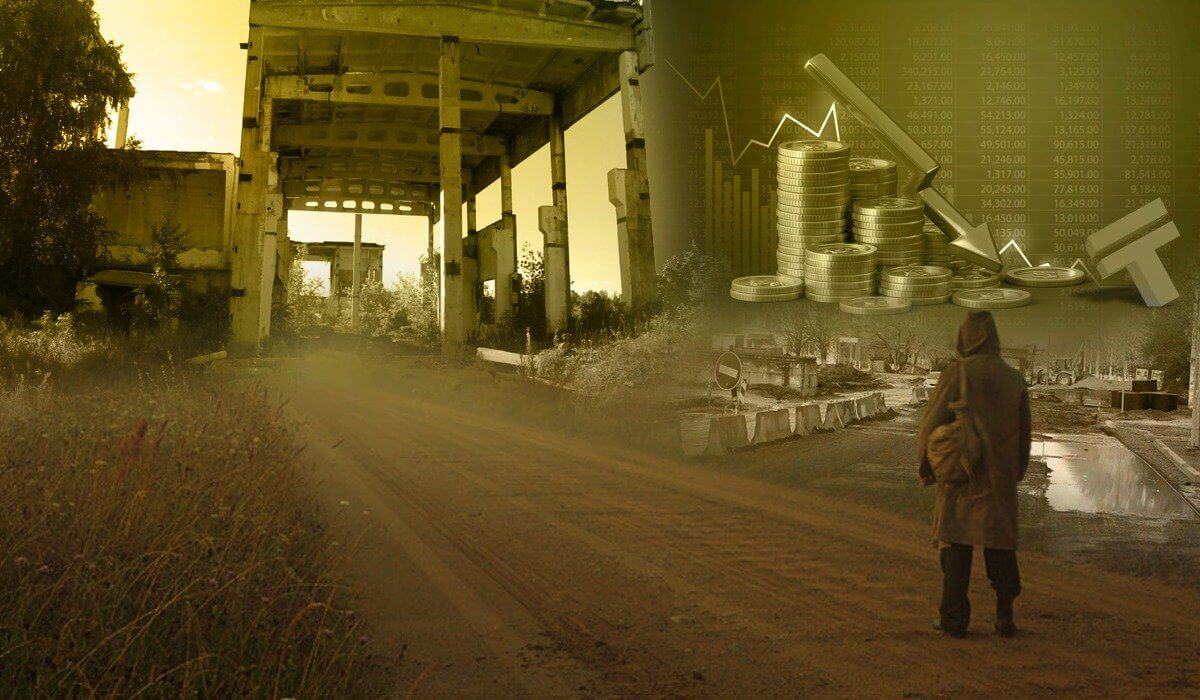
Recently, the World Bank called the years 2012 to 2022 the "lost decade" for the Kazakh economy. The analysts of the financial institution supported their conclusions with graphs showing the slow growth of the country's GDP and other important economic indicators. However, the peculiarity of the situation is that it was during these years that Kazakhstan implemented costly budget programs such as "Nurly Zhol," accelerated industrial-innovative development, and many others. Judging by the conclusions of the World Bank analysts, trillions of tenge spent on these programs were wasted. Who is to blame for these useless expenditures? And are there any hints that we have indeed emerged from the economic deadlock and found a new path for development? Or perhaps the World Bank made some mistakes, and Kazakhstan is developing quite successfully? These questions “Voice of the People” discussed with economists.
What did the World Bank say?
At the dawn of independence, as noted by World Bank analysts, Kazakhstan carried out a number of successful market reforms, and until 2008, they "pulled" the country's economy forward. But then the growth of Kazakhstan's economy slowed down, and in the years 2012 to 2022, a slowdown in productivity growth of various companies was recorded from 4.5% to 0.9% per year.
The modernization of companies, the efficiency of goods distribution, and entrepreneurial activity also slowed down.
As noted by World Bank analysts, the years from 2012 to 2022 can be called a "lost decade" for the Kazakh economy. As for the various state programs that Kazakhstan actively developed during this time, in the opinion of the World Bank, they only made things worse.
"The predominance of extensive state support likely unintentionally contributed to the emergence of a large number of zombie companies that barely survive and have no motivation to expand," write the analysts of the World Bank.
Looking ahead, the World Bank's forecast for Kazakhstan is cautiously optimistic. They believe that the growth of Kazakhstan's economy will slow down to 3.4% in 2024 and then return to 4.5-5% in 2025, mainly due to oil production.
Meanwhile, the Kazakh government has more ambitious plans for the coming years. Firstly, by 2029, the country's GDP should double: from the current $225 billion to $450 billion, and secondly, the economy should grow by at least 6% annually.
Investor? Show the contract!
Doctor of Economics, Professor Baurzhan Isabekov considers the planned indicators to be very ambitious and hardly achievable.
"The state of Kazakhstan's economy is determined by several factors. The first of which is resource intensity. The material and technical base is outdated, and therefore the cost of produced goods turns out to be uncompetitive. The second is the raw material orientation. The wealth in our subsoil should belong to the people and God, but the benefits from it are received by completely different individuals," the professor reminds.
Photo from social media
In recent years, there have been weak attempts to rectify the situation; for example, there was a statement about the intention to review contracts concluded back in the 90s with major subsoil users. And, as Baurzhan Isabekov suggests, when this is done, one can expect a gradual growth of Kazakh industry.
"There are already Kazakh service companies that can provide a much wider range of services to foreign investors than is currently the case. It's just that this increase is not specified in the contracts. For now. In addition, it is necessary to revise these contracts in such a way that as much of the raw materials extracted from Kazakh subsoil as possible is sent for processing within the country. Small and medium-sized businesses should be maximally involved in this. Therefore, I believe that every large businessman operating in our country should have a contract for mandatory cooperation with smaller ones," he says.
At the same time, as the economist emphasizes, achieving what has not been accomplished in 30 years in just 5 years is unlikely. After all, this requires both political firmness and additional investments. But at least one can hope that Kazakhstan will not have any more "lost decades."
The state must leave business
As noted by the executive director of the Applied Research Center "TALAP" Askar Kysykov, the main "complaint" of World Bank analysts to Kazakh decision-making centers is the lack of structural economic reforms.
But this has been reiterated by domestic experts for many years.
"The previous government was mainly occupied with the anti-crisis agenda: the coronavirus pandemic, the situation in Russia, and so on – the government reacted more to challenges than solved the complex problems of Kazakhstan. Now, it seems to me, both business and society expect that the new Cabinet will carry out structural reforms and work for the benefit of the country's economy," the economist expresses cautious optimism.
Photo "Voice of the People"
As Kysykov is confident, it is necessary to start with bringing order to budget planning: the lion's share of all state money goes to social spheres – education and healthcare, however, Kazakhs are still dissatisfied with them and complain about corruption. Therefore, something is clearly going wrong.
The second important step towards the prosperity of the Kazakh economy, in Askar Kysykov's opinion, should be to reduce the state's share in it.
"Currently, the National Welfare Fund "Samruk-Kazyna" is managed by the government. It is managed ineffectively: the dividends they pay to the state are very low. At the same time, there is a high level of cross-subsidization. They do not operate on market principles. Therefore, we need to increase the efficiency of "Samruk-Kazyna" and simultaneously carry out decisive privatization," says the economist.
He reminds that a private investor, who risks his own money, has much higher motivation than the state, so all financing programs for new productions should primarily rely on private business, not on state support.
But even with all the right actions of the Cabinet, the result may be very slow.
"The task of doubling GDP in 5 years looks unrealistic. By what means? Doubling oil and metal production? Grain production? This is impossible because resources are limited. There must be other sources of growth. Essentially, the task is to create another economy – a non-resource one, which will exist parallel to our existing resource economy. This requires large investments. And where to get them – I have big questions and doubts," summarizes Askar Kysykov.
Our economy is sick and not healing
Economist and author of the book "The Economy of Kazakhstan. Myths and Reality" Aydarkhan Kusaynov fully agrees with the negative assessment of the World Bank. Moreover, as the expert suggests, we have a long way to fall, as Kazakhstan has been suffering from the "Dutch disease" for many years.
"The high economic growth of the early 2000s was due to the fact that in the 90s our industry was completely idle. Factories were inactive, and then they began to be massively converted into shopping centers. And naturally, this "movement" led to development. But if our factories had been operating in the 90s, and then we had fallen ill with the "Dutch disease," everyone would have seen it immediately because there would have been an economic decline due to the halt of real production: industry falls, while trade grows, clearly something is going wrong," he says.
Thus, all the growth of the Kazakh economy in the early 2000s is solely due to the high exchange rate of the tenge, which occurred solely because of high oil prices.
Photo from social media
"2008-2009 was a moment of truth. The most correct thing at that time would have been to recognize the Dutch disease and devalue the tenge more strongly. Yes, at that moment we would have had more obvious and severe consequences of the crisis, but we would have been able to restore our industry. But no one really wanted to "heal," the tenge was devalued not to 200 tenge per dollar, as I suggested, but to 150. And various programs such as GPFIIR, "Nurly Zhol," and so on were invented to support businesses. Essentially, we treated some symptoms of the Dutch disease, but not the disease itself," explains Aydarkhan Kusaynov.
However, as the economist notes, there are no clear signals indicating that the country has started to heal, at least now: the exchange rate of the tenge is still much higher than it should be for the development of domestic business, and the oil money, which should be "isolated" from reality in the National Fund, is actively spent so that Kazakhs do not notice the deep problems of the economy and industry.
And if nothing changes, as Aydarkhan Kusaynov suggests, the day is not far off when World Bank analysts will release a report on a lost fifteen years and even a lost twenty years for the Kazakh economy.
To avoid this, the economist believes it is necessary to take very unpopular measures among the people, including the devaluation of the tenge.
"In fact, it seems to me that it is time to stop measuring everything in dollars. We are a sovereign country, GDP should be calculated in our national currency. From the perspective of a normal consumer – let the dollar cost 1000 tenge, as long as the tenge is enough for everything in Kazakhstan. After all, our incomes are in tenge, prices are in tenge. And if you think in tenge, calculate in tenge, then the goals will be different: to keep inflation in tenge, to increase incomes in tenge. And so on," explains his point of view the economist.
Is it not as bad as the World Bank says?
Economist and head of the analytical center DESHT Institutional Transformation Group Kuanish Zhaikov could argue with the conclusions of the World Bank analysts.
"I would not agree that this was the worst decade, although it looks that way by macro indicators. First of all, there were the 90s, when our entire economic system, which had been artificially supported for decades, finally went bankrupt. Hyperinflation, unemployment, unpaid wages, disconnection of utilities, the departure of 4 million abroad, rampant crime... I don't know how one can compare this with the quite prosperous 2010s. And in general, we have only been independent for 30 years and some," he reminds.
Photo: bes.media
The economist links the economic decline in recent years primarily to the reduction in the inflow of foreign investments in Kazakhstan's subsoil use. By the way, this was largely due not only to the personal desires of investors but also to the policy of Kazakhstan itself, which stated that from now on the priority is processing, not raw materials. And the non-resource sectors of the economy, as Kuanish Zhaikov reminds, have been demonstrating growth of about 5% all these years.
"The fact that the effects of new factories are not visible to the residents of post-industrial Almaty and Astana says nothing. In the places where they opened, important changes occurred. We have a large and scattered country, each "well" lives its own life. Yes, there were no new non-resource "Tengizs" and "Kashagans," but that is unrealistic, frankly speaking. The potential of our non-resource exports is quite low because we are surrounded by not the richest countries; who and what should we supply?" Kuanish Zhaikov calls for switching off alarmist sentiments.
He also reminds about the high level of digitalization in Kazakhstan, which even foreigners admire, and suggests adequately assessing other indirect factors of development.
"A baby boom. In the 90s, things were so bad that the birth rate fell below the simple reproduction of the population. And now Kazakhstan ranks first in the world in changing the population structure in favor of children. I am sure that soon data will come out showing that not only the poor segments of society are giving birth," says Zhaikov.
But even considering such an optimistic view of Kazakhstan, the economist weakly believes that our country will manage to double its GDP in 5 years. As he suggests, such a high bar was set by the President for the government primarily to stimulate discussion about further liberalization of the economy, as one cannot even dream of rapid growth if private business is suffocating from taxes and cannot cope with the competition posed by quasi-state companies.