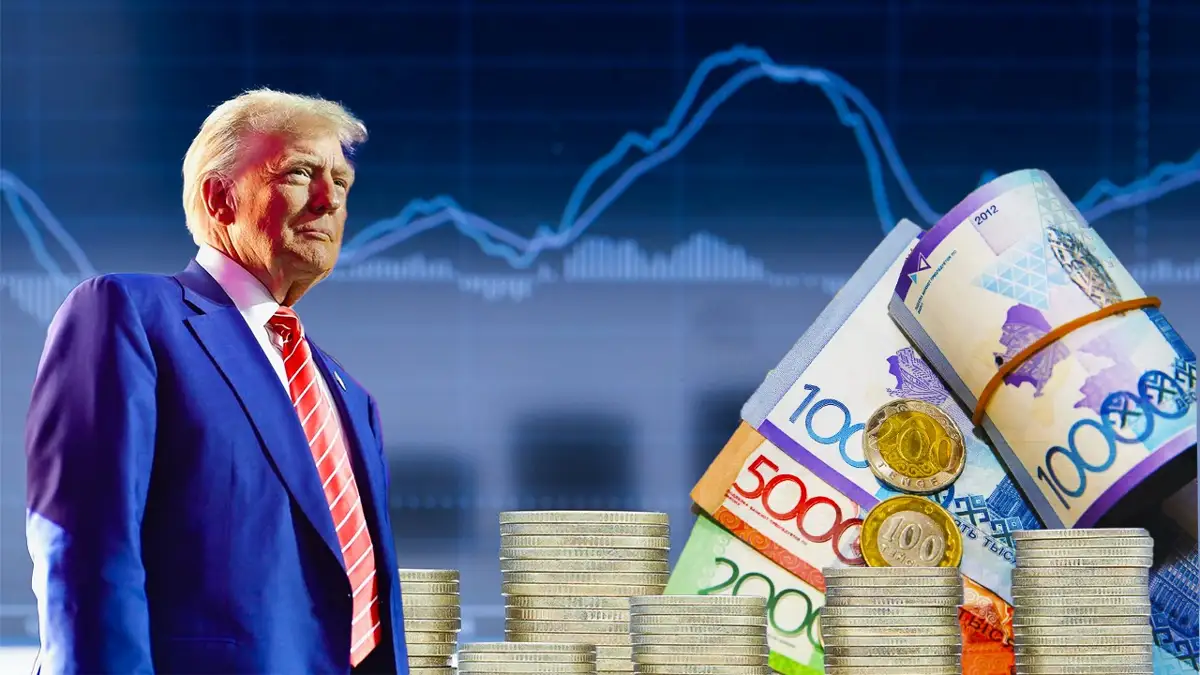
On January 20, Trump officially took office as President of the United States. The exchange rate of the US dollar at the end of the daily trading on KASE on January 20 slightly decreased against the tenge.
Economist Arman Beisembaev noted that this is a normal market reaction.
— Yesterday, the inauguration of Donald Trump took place. We observed the dynamics of the dollar exchange rate, and it slightly fell. This phenomenon can be described as 'buy on rumors, sell on facts.' Since Donald Trump was elected in November last year, the dollar has been steadily strengthening, but it began to weaken during the inauguration. We saw that yesterday there was an increase in other currencies, such as the euro and the British pound. Such market behavior should not be surprising, — he said.
Photo: from personal archive
According to him, the further dynamics of the dollar exchange rate will depend on the decisions made by the newly elected President of the United States, who promised to implement a set of measures.
— I do not think that this will have any serious impact on Kazakhstan in the short term. But there are certain risks in the long term. These risks may begin to materialize in the second half of the year when it becomes clear in which direction Trump's policy will move. Also, in the second half of the year, the conflict between Russia and Ukraine should be resolved. The outcome of this conflict will have a significant impact on the fate of our region, — noted Arman Beisembaev.
The expert noted that Donald Trump, seeking to avoid mistakes similar to those that occurred in Afghanistan, does not want to appear weak on the international stage. Therefore, in the expert's opinion, Trump will try to resolve the current conflict, but the process will be complicated and far from quick.
— The dynamics of the tenge exchange rate will largely depend on the state of the Russian economy. There are many questions here. So, in the first half of the year, I wouldn't expect anything terrible, but the problem may manifest later. I believe that the most difficult times for the Russian economy will begin after the conflict ends. At the moment, Russia's economic growth is supported by the military-industrial complex, which allows other sectors to stay afloat. For example, they already have alarming signals about logistics problems — this is the first sign that the economy may enter a crisis phase. Typically, when logistics start to fail, problems in other sectors follow. There are also issues in agriculture caused by a labor shortage. These problems may manifest in the second half of the year, — added the economist.
Further weakening of the ruble may negatively impact the economy of Kazakhstan.
— In the first half of the year, the tenge exchange rate is likely to remain in the range of about 530 tenge per dollar. However, there are all chances for a moderate strengthening of the currency, and it is quite possible that we will return to levels of 505-510 tenge per dollar. This is a realistic scenario, as market dynamics are not always linear, and there are wave-like fluctuations in financial markets. Nevertheless, if certain risks materialize in the second half of the year, there is a likelihood of a reversal. In that case, the tenge exchange rate may return to the mark of 530 tenge per dollar, and in the worst case, weaken to 550 tenge. This is again assuming that risks will materialize. Additionally, it should not be forgotten that Trump may unleash a trade war, and a US strike on China will inevitably affect Russia, which, in turn, will impact the economy of Kazakhstan, — believes Beisembaev.
Economist Askar Kysykov noted that two key factors influence the dynamics of the tenge — oil prices and the Russian ruble. Kazakhstan faces significant risks in both areas.
Photo: from personal archive
— There is a risk of falling oil prices, but I do not think that even considering Trump's statement that he will 'flood the world with oil,' this will lead to a critical drop in prices, — says Kysykov. — The price may decrease slightly, but I do not expect a critical decline. The greater risk for Kazakhstan comes from the ruble. We import a lot, and we have a historical parity — 5 tenge per ruble. This will have a significant impact on the tenge exchange rate, — said the speaker.
There is currently high demand for foreign currency in Kazakhstan due to devaluation expectations, the expert noted. Therefore, the National Bank is forced to intervene and conduct interventions to curb the exchange rate growth.
— I think that pressure on the exchange rate will continue, but it is important to consider that the National Bank has all the tools to maintain stability. It will smooth out volatility and will not allow destabilization of the currency market. Therefore, in the long term, the tenge exchange rate will weaken, but there will not be sharp fluctuations. I expect the exchange rate to remain within 530-550 tenge per dollar in the first half of the year.