We do not know for sure whether economists, like former Minister of National Economy Bishimbaev, believe in astrology, but on May 8, a New Moon occurred at 19 degrees Taurus in conjunction with Uranus. In the coming month, this will bring unpredictable events in the economic sphere. However, even without the forecasts of star specialists, we have been observing a perfect storm situation in recent years. In April, the IMF published a report on the prospects for the global economy. According to experts' calculations, the global economy will grow by 3.2% this year and next, at the same pace as in 2023. In developed economies, growth will increase from 1.6% in 2023 to 1.7% in 2024, while in developing countries, it will decrease from last year's 4.3% to 4.2% in 2024. Global inflation this year will be 5.9%. The IMF believes that the forecast for global economic growth in five years (at 3.1%) is the lowest in decades. The World Bank believes that growth in the global economy in the first half of this decade may be the weakest in the last 30 years. In Central Asia, growth rates this year are expected to drop to 2.4%. Globally, stagnation or slight growth is anticipated. The World Bank focuses on the fact that the escalation of geopolitical tensions in the near future may create new threats for the global economy. For many developing countries, the medium-term forecast has worsened due to the slowdown in growth rates in most major economies, stagnation in global trade, and the most severe tightening of lending conditions in decades. The growth rate of global trade in 2024 will be only half of the average over the ten years preceding the pandemic. By the end of this year, experts estimate that nearly every fourth developing country and about 40% of low-income countries will become even poorer than before the pandemic.
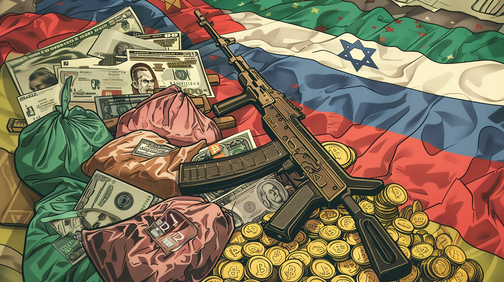
Bunker, Kalashnikov, and Gold
How to preserve and multiply your assets in conditions of global instability, military conflicts, high inflation, climate shocks, and rising debt? Where to invest if there is a war tomorrow? It should be noted that a number of experts believe that the world is already in the stage of a Third World War, which is unlike traditional military-political conflicts – it is a war for resources, an economic war. Financial analyst Arman Beisembaev noted on this matter: this is no longer the format of past wars, when dozens of countries unite and act as a single front against one enemy.
“The world is gradually plunging into a crisis associated with the active phase of deglobalization: the global economy is undergoing transformation, and the relationships, trade flows, and logistics are being revised and restructured. Conflicts will periodically arise along the lines of demarcation of economic blocks, including currency ones. In conditions close to a Third World War, it hardly makes sense to invest anywhere except in physical gold in the form of coins or bars. Especially if your place of residence could potentially be in a combat zone in the foreseeable future,” noted the interlocutor of TAJ.report.
In such a scenario, one should invest in canned food, pasta, ammunition, a Kalashnikov rifle, and build a bunker capable of withstanding a nuclear strike.
“But this is the most negative scenario. If we consider less catastrophic options, we keep in focus that there is currently no alternative to the dollar. And one can invest in the American currency. But here much depends on the size of your capital: if we are talking about amounts up to 5 thousand dollars, then put it in a bank deposit and don’t worry. If it’s hundreds of thousands of dollars, then it might be worth converting savings into different currencies,” said the financial analyst.
At the same time, he believes that in the conditions of deglobalization of the world and the creation of separate economic and currency blocks, the dollar will cease to be a global reserve currency in the next 10-20 years and, like other currencies, will move into a certain habitat.
Arman Beisembaev - financial analyst
“China has plans to expand the yuan zone in Southeast Asia, which it would like to include Japan. Japan gravitates towards the USA and would like to remain in the dollar zone. Russia has ambitions to create a ruble zone, and apparently, Kazakhstan is in its orbit. We are unlikely to enter the yuan zone,” added the expert.
Treasuries - yes, crypto - no
Continuing the topic of investments, he named securities - primarily from the American stock market.
“Consider debt securities, U.S. government bonds - the famous treasuries, which have quite good yields. If in Kazakhstan the yield on dollar deposits is 1%, then treasuries yield 5%. They are considered super-reliable securities, with a risk of default or bankruptcy that is practically impossible. Recently, American stock market shares were at their peaks, now they are slightly declining. Right now, I wouldn’t buy them – I would wait for the acute phase of the crisis, which I think will occur in the second half of 2024, maybe 2025,” shared the financial analyst.
The famous Jewish saying “Buy when rivers of blood run in the streets” works wonders in relation to the stock market, he added.
“The peak of negativity will indicate who has sunk, and from this bottom, one can look at which stocks to buy. When these avalanche flows of crisis settle, it will become clear what to take from the stocks of surviving companies – they are the ones that have a good foundation for the future. In the case of bankruptcy of companies, the stock prices will be zero, and no one will return that money to you,” emphasized Beisembaev.
As for cryptocurrency, he sees no prospects here.
“You can speculate, but I wouldn’t invest seriously. I believe that cryptocurrencies have no future. Technologies with blockchain will develop primarily. At the same time, there will be digital currencies, the monopoly on the issuance of which will remain exclusively with the state. That is, crypto money will remain in the form of crypto dollars, crypto euros, crypto rubles, crypto tenges, and so on,” replied the financial analyst.
Among tangible assets, he suggests considering real estate.
“Although it is considered a low-liquid asset that cannot quickly bring money. And once again about gold – investments in it have become relevant against the backdrop of the collapse of the global currency system,” said the expert.
What does renting things and water have to do with it
In addition to deglobalization, the world is facing a second paradigm – the construction of a new technological order, the analyst emphasized.
“Big data, biopharmaceuticals, biotechnology, Elon Musk's Neuralink - implanting a chip in the brain, controlling various objects with the power of thought. At this stage, technologies are being tested, but in the foreseeable future, with the power of thought, you will be able to turn on the light in the house, the microwave, and take eggs out of the refrigerator. By the time you reach the kitchen, everything will already be done. Such a world will happen if a nuclear war does not start,” our interlocutor is confident.
He also highlights a certain probability that personal ownership of things will become unfashionable.
“There will be no sense in having things at your personal disposal - everything will be common, rented. We already live in such conditions: apartments, cars, scooters, rental services for mobile phones are emerging. You pay monthly for using the device - like on credit, and after a year you can pay the remaining amount and take the phone, or you will be given a new rented device. We watch movies in theaters on streaming services, listen to music, and read books. If you want to wear a T-shirt - leave a small amount in the store, wear it for a couple of days, and return it, taking another item. Or a certain subscription in stores can be opened on the same principle,” the analyst projected models of tomorrow.
Therefore, one should look at the sectors of the economy, companies that will be engaged in this, and invest in their stocks. Another life hack from the expert is related to resources.
“The problem of the future, which all ecologists talk about, is water. Companies engaged in the extraction and exploration of water resources, water purification, and environmental projects are sitting on the gold of humanity's future. Moreover, the deficit of clean water in the world is growing, and the demand for it will only increase. Or pay attention to companies and funds that deal with water resources. And, of course, do not forget about artificial intelligence and the stocks of participants in this market,” Arman Beisembaev said.
Taxis and pizza from drones
In other words, it is important to keep in mind the new technological order and follow the trends.
“If humanity does not destroy itself, we are in for a leap in progress. Although wars usually lead to it – the same nuclear bomb appeared during World War II and gave a push to other nuclear technologies – nuclear power plants, small modular reactors, and others. Subsequent wars led to the development of the internet, mobile communications. That is, these were primarily military technologies that later entered the mass market. Even the microwave went through this path,” emphasized the interlocutor.
The Russian-Ukrainian war has given a boost to the development of drone technologies, including those based on artificial intelligence.
“And air taxi drones - this is also our future. Drones were originally a toy for enthusiasts, but now they are used in battles against opponents: they observe, bomb, kill. Sooner or later, the war will end, but the technologies themselves will continue to live in a different capacity. And then scientists and marketers will get involved, who will think about how to use these things for profit in peaceful life,” believes the financial analyst.
He recalls the sluggish raw attempts to use drones for food delivery made in 2017-2019.
“And the war has led to the fact that these technologies are being honed before our eyes to a razor's edge. On the front, it is strategically important to drop a bomb on a group of enemy personnel; your drone must fly with centimeter accuracy and drop munitions. Whether you will live in the next second depends on this. These skills will ensure the delivery of goods in peaceful conditions. A drone with pizza flies to your window, and you receive the order through the window,” the interlocutor described the picture of tomorrow's life.
And according to his forecasts, one should invest in stocks and everything related to the corresponding industries.
The best investment is in oneself
Economist Kuanysh Zhaikov does not yet believe in a Third World War, noting that politics is a very pragmatic sphere, and fanatics ended in the 20th century.
Kuanysh Zhaikov - economist
“Where to invest? - Again, it depends on the size of the assets. The best investment is the person himself. Invest in language knowledge, education and skills, social connections. Invest in children so that they are ready for different conditions. We are talking about how to ensure income in the future in case of anything. If this is in place, and on top of that, there are small assets - then, once again, I would not consider anything beyond deposits and passive investments in index funds. If the assets are very large but generated within the country - I mean super-rich people - then participate in the construction of this country. Help strengthen its security, political stability, and economic system. There is no other way,” said the economist.
The problem lies with those who are stuck between the last two categories. When there are already normal assets, but not enough to influence the system, he added. Economist Askar Kysykov believes that if we are talking about the average Kazakhstani, it is better to keep savings in those instruments that will provide maximum access to them.
“That is, they should be liquid assets for which you can quickly get your money back. This is, of course, cash. But there are certain costs to storing cash at home. For example, it is legally prohibited to keep more than 34.5 million tenge at home. One of the basic tools for storing money is a deposit, especially since the rates on tenge deposits are good. So if your main expenses and payments, including loans, are in tenge, this is a convenient option,” said the economist.
Risky bonds
Large sums should be diversified into different currencies and currency deposits – euro and dollar, as well as in gold, he continued.
“Another type of investment is bonds. Currently, there are many issuers in Kazakhstan issuing bonds, including in dollars, with good rates. Last year, the rate was 12% for dollar bonds. I have heard that many bonds are now offered in tenge at 20% and in dollars at about 10%. But it should be understood: bonds and stocks are not quite liquid assets, there is a serious risk associated with them. In the event of a crisis, when you want to exit them, you may do so with significant losses of funds and time,” Kysykov clarified.
Considering the most negative scenarios, he advises the following:
“If a person or family has a need for something and has free money, it is better to invest in what will improve comfort and living conditions. If you need to renovate, do it now. Buy durable goods if necessary – a car, for example. I believe it is better not to save but to invest in physical assets that will remain with you. Essentially, this is investing in yourself,” emphasized the economist.
Many talk about falling prices in the real estate market, but our interlocutor sees no reason for a serious decline.
Askar Kysykov - economist
“If you need housing – buy it when you need it, do not wait for a better day when you hope to win by falling prices. Buy housing, increase its comfort, expand living space. The best time for this is now,” the expert is confident.
Time to gather cash
Financial analyst Rasul Rysmambetov considers it optimal to divide the portfolio into two parts.
“One part, in tenge, can be placed in a bank, while the currency part - in a safe or in a currency deposit. It is time to recognize that the best deposit is a person and his health. Besides the dollar, one can look at the euro or other foreign currencies,” said our interlocutor.
His colleague Andrey Chebotaryov, like the previous speakers, noted that the form of asset storage depends on your assessment of the status quo.
“If you are sure of the beginning of a Third World War, then the best investments will be in building a concrete bunker and bulk purchasing iodine, preferably in tablets - it will come in handy. If we are only talking about a possible threat, then it further depends on your attitude towards risk and everything else. Gold is traditionally considered a protective asset, but now it is acquiring the symbols of an investment asset - people invest in it because it is rising in price. Everyone decides for themselves what and where to store, the main thing is to understand for yourself: will there be a Third World War or not,” commented the financial analyst.
A person tends to believe that everything will be fine and that they will get through it, he continued.
“Otherwise, everything will be very bad, and gold may not help, and the dollar even less so. Then it is unknown what to invest in. So in the criteria of a Third World War, I cannot advise anything, but if there is no war, then now is the time for cash and gold. Cash is always the most liquid asset in case of a crisis, which can be converted into goods and services more and faster than anything else,” said Chebotaryov.
Expectations dictate investments
Financier Murat Temirkhanov, in turn, believes that assets should be held in different things.
“If there is a crisis, then cash is the best. However, I do not expect a crisis: in China, economic growth is good, in the USA they are worried about high inflation and economic stagnation, but in my opinion, everything is also fine there. In the absence of a crisis, it is better to diversify your investments: part in deposits, part in securities, something in gold. I do not recommend Bitcoin – you need to be a daring risk-taker for that,” said the interlocutor.
Murat Temirkhanov - financier
And if you expect a crisis, it is better to convert to cash and sit on it. But the specialist recommends keeping these eggs in different baskets: in tenge, dollars, euros.
“If you do not expect a catastrophe in Kazakhstan, then most or half can be kept in tenge, as the native currency mitigates currency risks. The remaining part should be converted into foreign currency. Everyone always looks at the dollar and euro – this is about the real market economy. Although the EU is now on its own, America is too. The yuan is not that widespread. But the Chinese currency constantly raises concerns - there is too much politics involved. So if you are sitting on cash, distribute your eggs across different baskets,” noted the financier.
As a citizen of pre-retirement age, he tries to save for the future - to live well in old age.
“I keep part of my savings in mutual funds. Which ones exactly - does not matter. They can be currency funds, funds investing in securities and other assets. Inflation in Kazakhstan is high, and this method is a good investment. I keep part of my assets in bank deposits. I am considering investing in a pension annuity. But, to be honest, in our country, it is not profitable to do this; I do not know what the Financial Market Regulation and Development Agency (AFRR) is looking at. They incorrectly calculate life expectancy, the duration of pension payments. Therefore, I have to look at foreign currency annuities again,” shared Murat Temirkhanov with us.
The interlocutor did not analyze investments in the context of a Third World War.
“More than Ukraine and Russia, concerns are raised by Iran and Israel. But there is a feeling that it is not in Iran's interest to escalate the conflict, just as it is not in Israel's. There is hope that the situation will not escalate into a large Middle Eastern conflict. Although in politics, it is difficult to predict, as in economics,” concluded the financier.