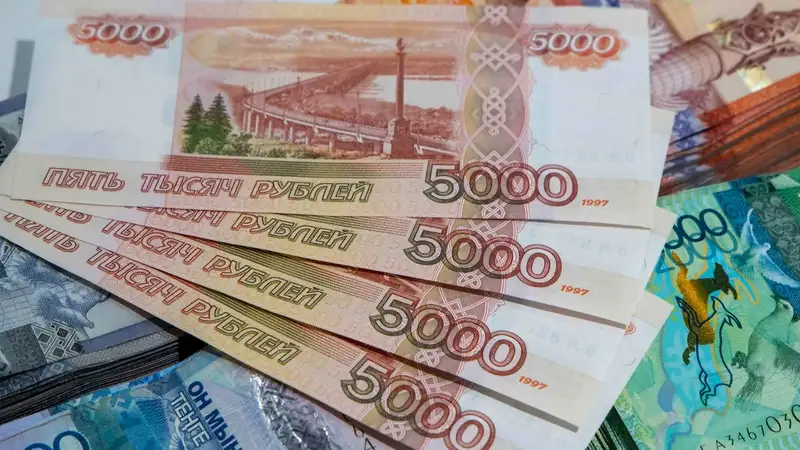
If we open the latest press release from the National Bank of the Republic of Kazakhstan, we will see that on June 19, 2024, the tenge continues to fall against all world currencies. The Kazakhstani currency is "deflating" even against such monetary units as the Armenian dram, Belarusian ruble, Iranian rial, Moldovan leu, Uzbek som, Ukrainian hryvnia, and so on. There is not a single currency that has depreciated against the tenge.
But while Kazakhstanis may not care much about the leu or dram, the "tenge-ruble" exchange rate is very painful due to the close economic ties between Russia and Kazakhstan.
Why is the ruble rising?
Such "currency swings" are quite natural, says economist Aydarkhan Kusaynov. This is more of a seasonal phenomenon rather than a trend.
"For some reason, we always forget that the tenge strengthens in spring, while it weakens in summer and autumn. There is nothing strange about this decline of the tenge; it happened last year and the year before. The difference is that every year additional nuances are added to this trend. Today, it is the reduction of transfers from the National Bank, the shortfall in tax revenues to the republican budget, and the sanctions from the USA against the Moscow Exchange." Aydarkhan Kusaynov
Moreover, it should not be forgotten that the tenge was significantly overvalued at the beginning of the year, and the current exchange rate is closer to what the government had planned when forming the budget for 2024-2025, the economist believes.
The strengthening of the ruble is a temporary phenomenon, believes the director of the Applied Research Center "TALAP" Askar Kysykov. Due to sanctions, currency trading with the dollar and euro in Russia has moved to the over-the-counter market, and the exchange rate is formed based on interbank operations. It is obvious that this exchange rate can no longer be called market-based; it is already managed.
"The ruble has started to orient itself towards the yuan. But in China, the currency exchange rate is also managed. Thus, Russia is placed in a serious dependence on the exchange rate policy of the Bank of China. A similar dependence is observed with the tenge – but on the Russian ruble." Askar Kysykov
Over the past two years, the structure of the currency market in Russia has fundamentally changed. More than half of the trading occurs in the yuan/ruble pair. The share of the dollar has decreased from 80% to 30%. And in settlements with other "friendly" partners, Russia has also switched to national currencies. This is why the ruble is only strengthening – due to the pivot towards the yuan and the strict policy of the Central Bank of the Russian Federation.
At the same time, the expert suggests that the strengthening of the ruble against the tenge is a temporary matter.
"Historical parity: 4.5-5 tenge per ruble. In the conditions of the EAEU, a deviation from this parity is painful for us. A weak ruble means an increase in the cost of critically important imports, while a strong ruble means a loss of competitiveness for Kazakhstani goods." Askar Kysykov
Nevertheless, the situation is somewhat paradoxical. China manages the yuan, Russia manages the ruble, and in Kazakhstan, there is a floating exchange rate. How long will this last?
It should be noted that the lowest buying rate for the ruble at exchange points on the morning of June 19, 2024, was in Shymkent – 5.1 tenge; the selling rate was 5.23 tenge. In Astana, the buying rate was 5.13 tenge, and the selling rate was 5.36 tenge. In Almaty, they asked for 5.16 tenge for a ruble and sold it for 5.3 tenge.